Why Blackjack RTP Is Calculated Differently Than Slots
Slots just spin and the math is fixed. Blackjack hands you the wheel and asks what you do with it. That one difference changes everything about how return-to-player gets calculated.
The deal
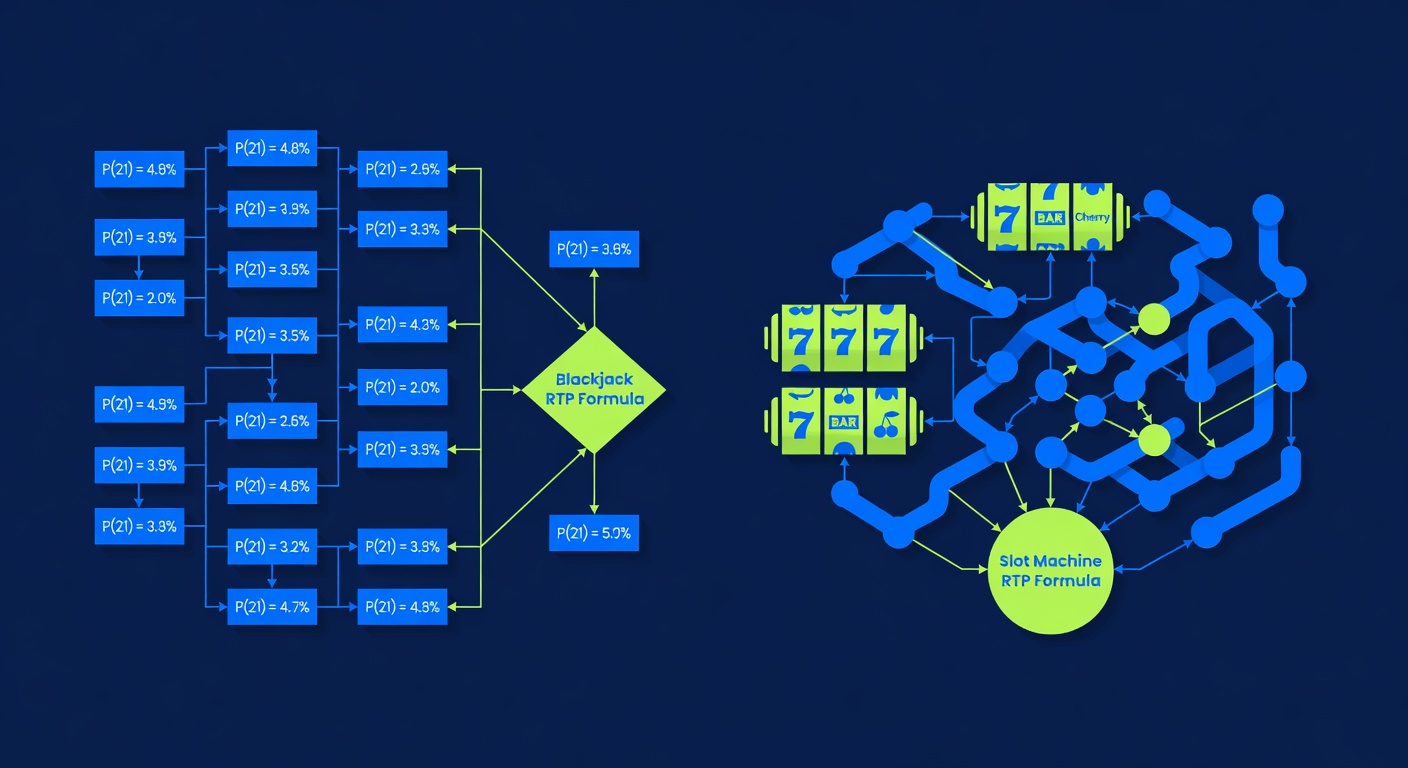
You walk up to a slot machine and the RTP is 96.5%. Full stop. The math is sealed inside the RNG, it runs the same way whether you're betting $0.20 or $20, and nothing you do with the spin button changes it. That number is the number.
Now you sit down at a blackjack table. The house edge is listed at 0.5%. But here's what that means: 0.5% against a player using perfect basic strategy, hitting and standing at exactly the right moments, doubling and splitting according to the mathematically optimal chart, never deviating. Change one decision and the edge moves. Make several bad decisions and you're not playing a 0.5% game anymore. You might be playing a 2% game, or a 4% game, purely based on what you chose to do.
Round 1: Slots: The Math Is Fixed Before You Arrive
Online slot RTP is calculated across the full probability distribution of all possible reel outcomes, weighted by their frequency. The software developer, say Play'n GO or Pragmatic Play, builds that distribution into the game math. A regulator like the Malta Gaming Authority or the UKGC then audits the stated RTP against actual game logs. The number on the information page reflects a mathematical fact about the game's construction, independent of any player.
Play a slot for 10,000 spins at flat bet. You will not necessarily see exactly 96.5% back. Variance means short-term results scatter widely. But the underlying probability never changes based on your choices, because slots don't give you choices that affect outcome.
Round 2: Blackjack: RTP Is a Function of Your Play
Blackjack is different because the game has decision points. Hit or stand. Double or not. Split or not. Each decision has a mathematically optimal answer given the player's hand and the dealer's upcard, and the 0.5% figure assumes you always find that answer.
Here are three spots where decisions visibly move the edge:
- Standing on 16 vs dealer 10: Basic strategy says hit. Many players stand out of fear. This single deviation costs roughly 0.06% in expected value per occurrence.
- Never splitting 8s vs dealer 9, 10, or Ace: Basic strategy says always split. Many players hate seeing two bad hands instead of one terrible hand. Also a mistake, though the magnitude varies by dealer upcard.
- Never doubling down: Basic strategy doubles on 11 against almost any dealer card. Skipping this spot, consistently, costs meaningful EV over volume.
The aggregate effect of these deviations is why casino managers have historically been comfortable with blackjack's low house edge. Most players don't play optimally. The actual average player edge is closer to 1-2%, depending on which studies you look at, not the 0.5% quoted in optimal-play scenarios.
Round 3: Why This Distinction Matters When You Read a Casino Review
When a review site says "blackjack RTP: 99.5%" they're giving you a ceiling, not a description of what you'll experience. That 99.5% is the mirror of a 0.5% house edge, achievable only with optimal play. A slots RTP of 96.5% applies to every player equally.
This creates a genuinely interesting situation. A slots player and a blackjack player can both read the same RTP figure, and it will accurately describe reality for exactly one of them.
Round 4: The Rule Variants Also Matter
Even optimal blackjack play produces different expected returns depending on table rules. A 3:2 blackjack payout is standard and worth roughly 1.4% to the player versus a 6:5 payout. Dealer stands on soft 17 reduces the house edge by about 0.2% compared to tables where the dealer hits soft 17. Double-after-split, re-splitting aces, late surrender: each rule variant shifts the math in small but measurable increments.
So the full picture looks like this: the RTP you see for a blackjack game assumes a specific rule set, assumes optimal play, and assumes you know what optimal play looks like in that specific rule variant. That is a lot of assumptions. Slots ask you to press a button.
Neither game is better. They're just measuring different things when they quote you a number.