Craps Don't Pass vs Pass Line: The Mathematical Difference
The Pass Line and Don't Pass Line at a craps table pay the same 1:1, but their house edges differ by 0.08 percentage points and their psychological profiles differ by considerably more. The math is simple. The social dynamics around it are not.
The deal
Start with the numbers, because they are clean and honest in a way the casino floor rarely is.
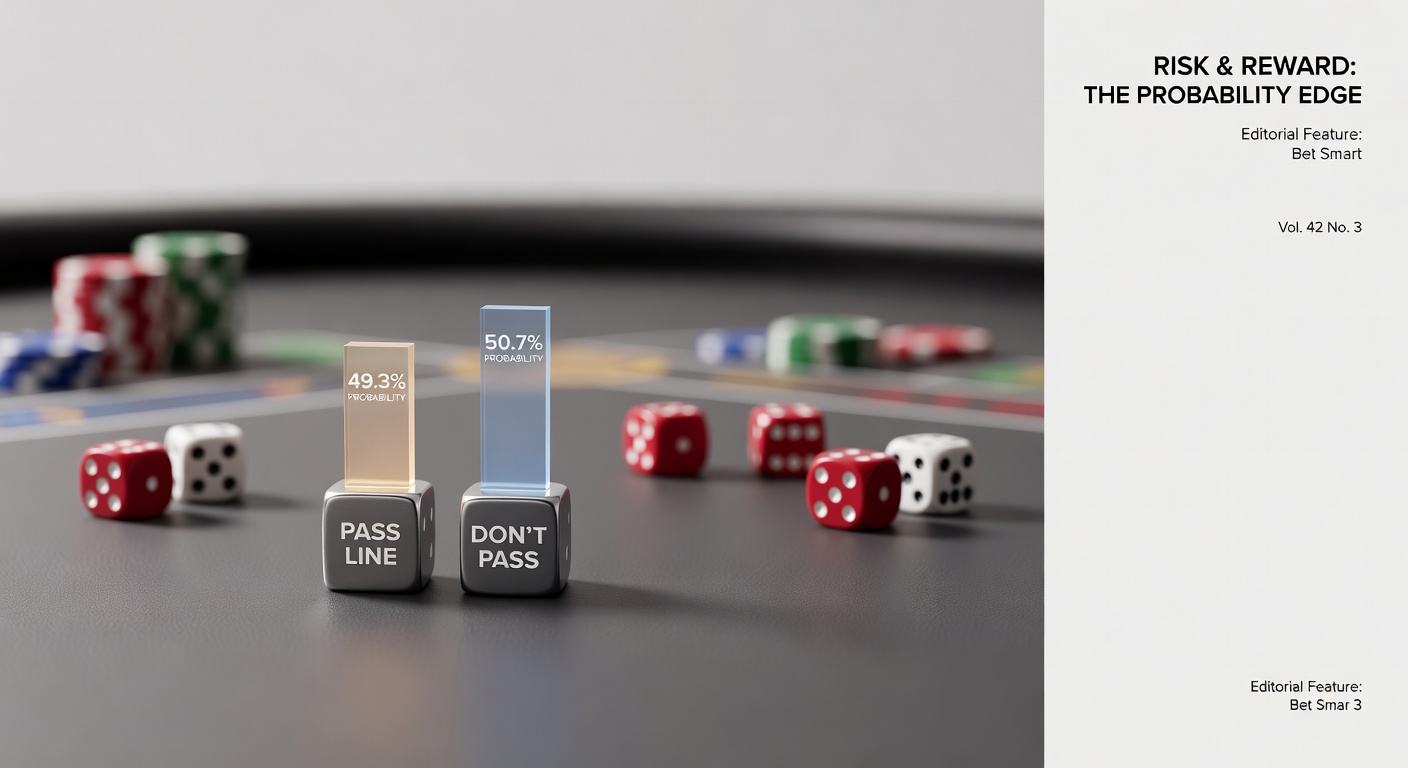
The Pass Line carries a house edge of 1.41 percent. The Don't Pass Line carries a house edge of 1.36 percent. The difference is 0.05 percentage points, depending on how you handle the bar on 12 (the pushed outcome that prevents the Don't Pass from being a true negative of Pass). Over a session of a few hundred rolls, that gap is statistically invisible. Over millions of bets, it is why Don't Pass is the technically superior wager.
Round 1: Where the Edge Comes From
The Pass Line wins when the come-out roll is 7 or 11, and loses when it is 2, 3, or 12. Any other number establishes a point, and the shooter then tries to repeat that number before rolling a 7. The probability distribution here is slightly in the shooter's favour on the come-out (8 winning outcomes versus 4 losing ones), but the point phase swings the edge back to the house.
Don't Pass works in reverse. It wins on 2 or 3, loses on 7 or 11, and pushes on 12 (or 2 in some casinos). If a point is established, Don't Pass wins if the shooter sevens out before repeating the point. The edge is slightly lower because the come-out disadvantage (you lose on 7 and 11 when most of the table is cheering) is less costly in pure probability terms than the house's structural advantage on the point phase.
The canonical way to reduce both edges further is the free odds bet, which carries zero house edge. A $10 Pass Line bet with double odds behind it at a standard Vegas game drops the combined edge to around 0.6 percent. The same structure on Don't Pass drops it to roughly 0.5 percent. These are among the lowest edges available in any casino.
Round 2: The Mental Accounting Problem
Richard Thaler's mental accounting framework, developed in a series of papers through the 1980s, describes how people sort money into psychological buckets that do not behave like fungible units of value. The craps table is a near-perfect demonstration of this.
Most players bet Pass Line. They cheer with the table, they celebrate with the shooter, and losses feel like shared misfortune rather than personal failure. The social architecture of craps is built around this collective orientation. The shooter is the team captain. The table bets with the shooter. Don't Pass bettors are technically playing correct expected-value optimisation. They are also, culturally, rooting for their neighbours to lose.
This is not a small thing. Casinos are social environments, and social environments impose norms. A Don't Pass bettor who wins loudly while everyone else loses their stake is not going to be invited to the next birthday craps session at the Venetian. Multiple studies on social conformity in gambling contexts have found that players under social observation shift toward cooperative bets even when doing so is negative expected value. The 0.05 percentage point edge from Don't Pass costs something real in social currency.
Round 3: The Loss Aversion Kicker
Kahneman and Tversky's prospect theory (1979) would predict something else, too. Don't Pass bettors, who win when shooters lose, experience a different loss pattern. The come-out roll produces more frequent small wins and pushes for Don't Pass, but the hit of losing on a 7 or 11 during the come-out, against table momentum, feels worse proportionally than an equivalent win feels good. Loss aversion coefficients in the gambling literature typically run at around 2:1, meaning a loss hurts approximately twice as much as an equivalent win satisfies.
For Don't Pass bettors, this means the structure of the game generates more emotionally salient losses in the come-out phase, precisely when the table is loudest and most socially pressured. It is one reason even sophisticated bettors who know the edge often default to Pass Line. The math is in one direction; the emotional arithmetic is in another.
Round 4: A Practical Framework
If you are playing craps and you want to make mathematically sound decisions:
- Pass Line with 2x or 3x-4x-5x free odds gets your combined edge to around 0.4-0.6 percent.
- Don't Pass with equivalent odds is marginally better in pure EV, by a fraction most sessions will never reveal.
- The single most important variable is table minimum versus your total bankroll. A $25 minimum at double odds on a $500 bankroll will produce ruin risk far faster than finding a $5 table with triple odds.
- Proposition bets (Any Seven, Hard Ways) carry edges between 9 and 16 percent. They are entertainment products, not bets.
The mathematics of Don't Pass is the better bet. The social mathematics of playing craps is more complicated than that.