How to Calculate the House Edge for Any Blackjack Rule Set
Casinos change blackjack rules the way protocols fork: quietly, with fine print that costs you money. Here's how to actually compute the house edge before you sit down.
The deal
Most blackjack players know the house edge is somewhere around 0.5% with basic strategy. They just accept that number the way people accept gas fees. "It is what it is."
Here's the thing: that 0.5% number assumes a specific rule set that many casinos haven't offered in years. Single deck, 3:2 blackjack, dealer stands on soft 17, late surrender available. Good luck finding that at the MGM Grand floor at 9pm on a Saturday.
If you can't calculate the actual edge, you're just trusting the house's documentation. And we all know how that usually goes.
Round 1: The Baseline and the Modifiers
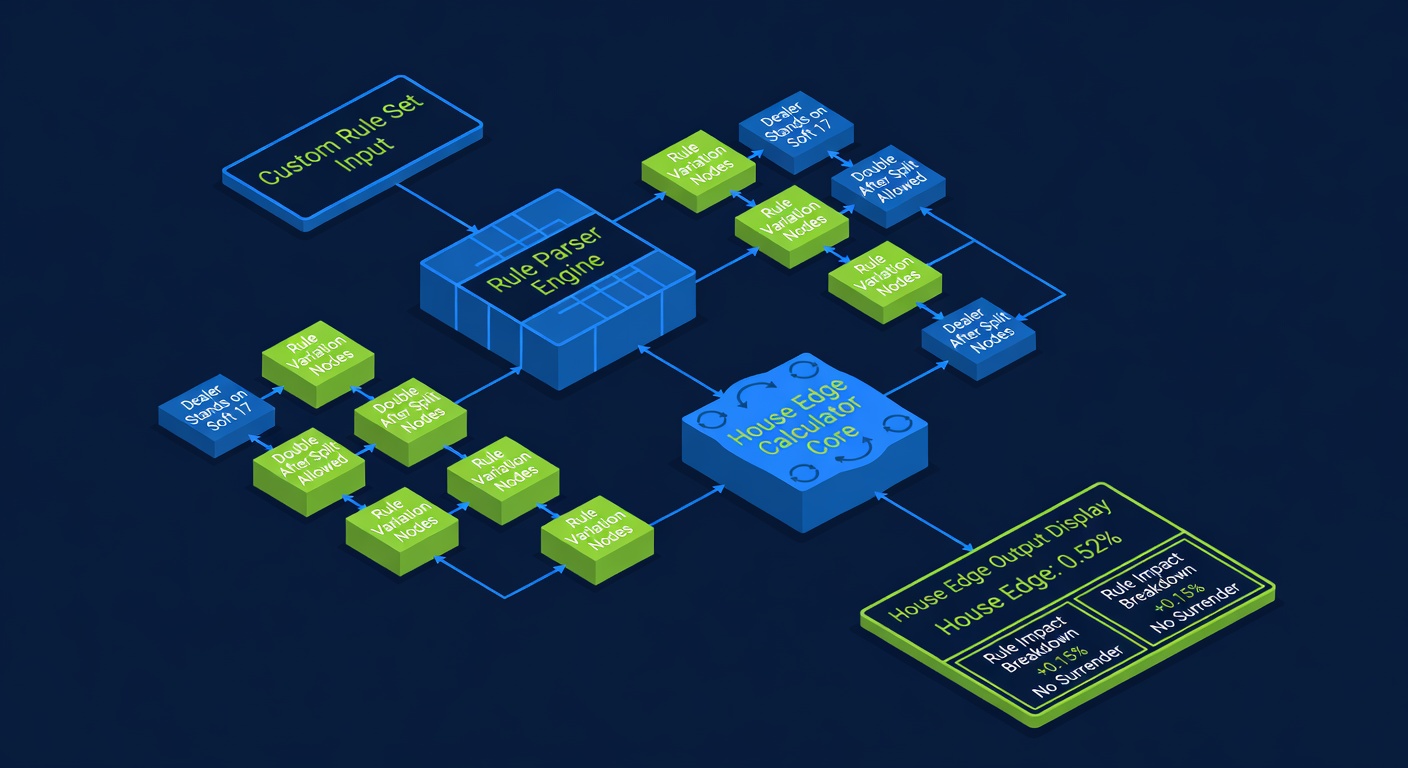
Start with a theoretical baseline house edge of 0.5% for a standard 6-deck game with basic strategy. That's your starting block. Every rule variation from there is either a tax or a rebate.
Here's a working modifier table:
- 6:5 blackjack payout instead of 3:2: adds 1.39% to house edge. This is the biggest single theft in modern blackjack. A $100 bet on blackjack pays $120 instead of $150. That 1.39% is not negotiable. Walk away.
- Dealer hits soft 17 instead of standing: adds 0.22%.
- No double after split: adds 0.14%.
- No resplitting aces: adds 0.08%.
- Single deck instead of 6 decks: subtracts 0.46%.
- Late surrender allowed: subtracts 0.08%.
- Early surrender against 10: subtracts 0.24%.
- Double down on any two cards (vs. 10-11 only): subtracts 0.23%.
Stack the modifiers. A 6-deck game with 6:5 payouts, dealer hits soft 17, and no surrender has a house edge of roughly 0.5 + 1.39 + 0.22 + 0.08 = 2.19%. That's not "low-edge blackjack." That's a game worse than many roulette variants.
Round 2: The Math Behind the Modifiers
Why does 6:5 vs 3:2 cost exactly 1.39%? Because the frequency of a natural blackjack in a 6-deck shoe is approximately 4.75% per hand (roughly 2 cards in 41 are an ace-ten combination, each way). That 4.75% of hands pay $30 less per $100 bet under 6:5. $30 x 4.75% = $1.425, divide by expected bet returns to get approximately 1.39%.
The calculation is deterministic. This is not vibes or community lore. The combinatorics of a 6-deck shoe are fixed. Anyone claiming a "hot" or "cold" deck is arguing against counting theory, which is provably wrong at scale.
The soft-17 rule costs 0.22% because the dealer, on a soft 17 (ace + 6), has a chance to improve their hand by drawing. They bust less often when they hit. That difference compounds across thousands of hands. Wizard of Odds maintains published basic strategy tables that document these modifiers to three decimal places if you want to verify.
Round 3: How Crypto Casinos Handle This
Here's where it gets interesting for anyone who's played on provably fair platforms. Games on sites running transparent RNG validation (Stake, Cloudbet, and similar) typically publish their house edge directly in the game metadata. Not buried in the terms. In the game header.
A blackjack variant there might say "house edge: 0.44%" and that figure is derivable from the published rule set. You can check it against the modifier table above. If the math doesn't match the stated edge, something is wrong.
Land-based and standard online casinos don't publish this. They expect you to find it in the fine print, or more likely not find it at all. Casinos licensed under the MGA (Malta Gaming Authority) and the UKGC (UK Gambling Commission) are required to publish RTP figures, but blackjack is often listed as a range rather than a precise figure for a specific rule set.
Round 4: The Takeaway
Five minutes of rule-checking before you sit down is worth more than any betting system you'll read about. Find the rule placard on the table. Check 3:2 vs 6:5 first because that one modifier can make a game 2.5x worse than advertised. Then layer in the soft-17 and surrender rules.
The information is on the felt. You just have to actually read it.