Why Hole Carding Is Different From Card Counting
A card counter learns the unseen. A hole carder sees the unseen. The difference is not philosophical. It is legal.
The deal
I am going to tell you a story because stories are the only way to make sense of temptation.
There was a man who worked in a casino poker room. He was a dealer. He dealt thousands of hands. One day, he noticed something: when a particular player won a hand, they would squeeze their hole cards differently. They would hold the cards at an angle where the dealer could see the corner.
He could see their cards. Just barely. Just enough to know what they were holding before any decision was made. For months, he saw their hand every time. He never said anything.
Then he quit dealing and became a player in that same room. He played against that particular person. When they did their squeeze, he knew their cards. He won.
That is hole carding.
Round 1: What Hole Carding Is
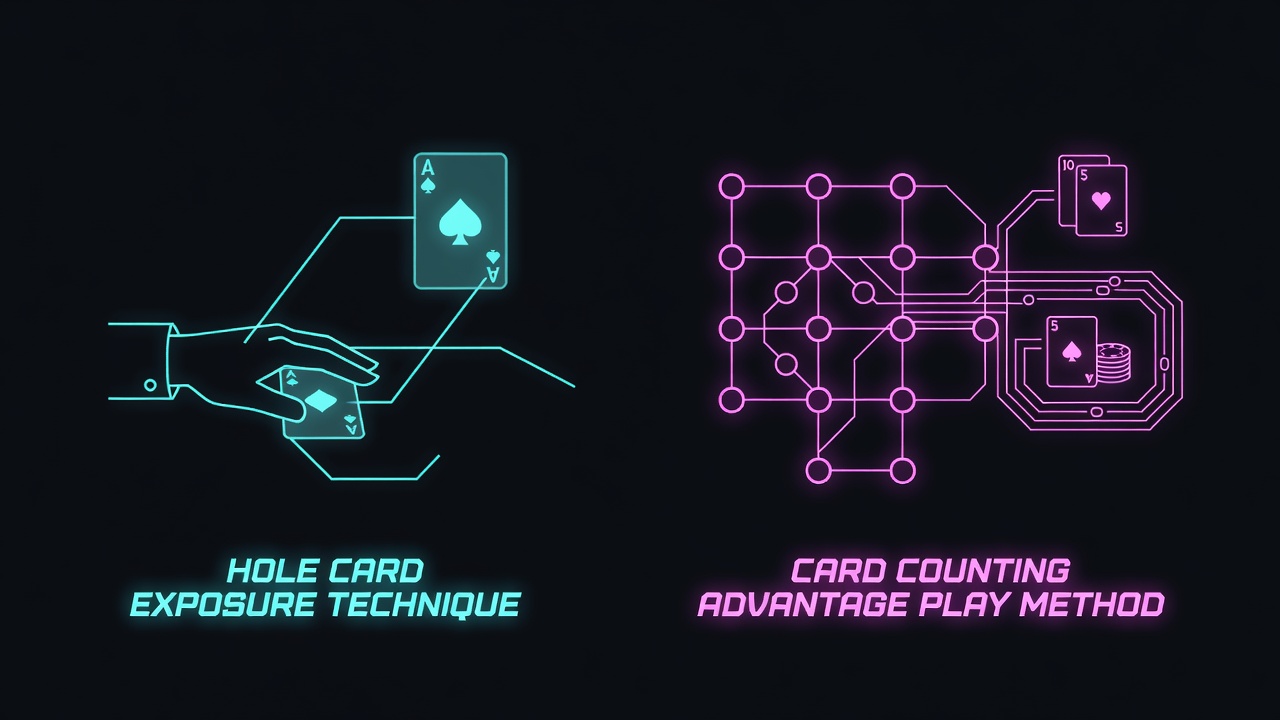
Hole carding is gaining information about unseen cards by watching the cards' handling, a poorly dealt hand, or a careless dealer. You see the cards. You are not supposed to see them. But you do.
The information is real. The card is what it is. You are not inventing data. You are observing data that was supposed to be hidden.
Round 2: What Card Counting Is
Card counting is the mathematical practice of tracking which cards have left the deck and using that information to adjust your strategy. You do not see the cards. You remember them. As cards are dealt, the deck's composition changes. The true odds change. You adjust your bets accordingly.
Card counting requires memory and mathematics. Hole carding requires observation and luck.
Round 3: Why The Law Treats Them Differently
In Nevada, card counting is legal. It is not cheating. You are using your brain to process information that is publicly available (the cards dealt face up on the table). A casino can ask you to leave, but they cannot prosecute you.
Hole carding is different. You are gaining information that was supposed to be private. The casino considers this theft of information, and courts have generally agreed. Gain information about hole cards through improper dealing or careless dealers, and you can be prosecuted for theft or fraud.
One is a battle of skill and memory against the house edge. The other is a violation of the information asymmetry the game depends on.
Round 4: Why Card Counting Almost Does Not Work Anymore
Modern casinos use continuous shuffle machines in blackjack. The deck composition resets constantly. Card counting becomes impossible because there is no deck persistence to track.
Additionally, the rules changed. Blackjack payouts dropped from 3:2 to 6:5. The house edge increased. Even perfect card counting cannot overcome this disadvantage in many casinos.
But the reason casinos started using CSMs was not out of legal concern. It was out of edge concern. Card counting, done perfectly, could overcome the house advantage. CSMs eliminated that possibility.
Round 5: Why Hole Carding Still Happens
Hole carding is harder to defend against because it depends on human error. A dealer, tired at 5am, holds a card slightly carelessly. A player notices. The player has information.
Baccarat and high-limit poker have seen hole carding attempts because the games have high stakes and high information value. One card seen is worth thousands of dollars in decision-making advantage.
The industry responds with technology (automatic shufflers, fixed card-handling protocols) and hiring practices (training dealers, auditing for sleepy dealers, rotating staff).
Round 6: The Moral Distinction
Card counting feels different because it rewards diligent study and sharp mental faculties. You are better at remembering. You win.
Hole carding feels different because it rewards catching someone else's mistake. You are catching a dealer or player in a moment of carelessness. You win.
One feels earned. The other feels like theft, because in a sense, it is. You are taking information that was supposed to be hidden. The information is real, the observation is real, but the taking of it is the problem.
Casinos do not care about the philosophical distinction. They care about their edge. They will ban any player who can reliably know cards they should not know, whether through counting or carding or any other means. The law, however, makes the distinction. One is permitted. One is prosecutable.
That distinction is what separates a smart player from a cheater.