Mines Game at Crypto Casinos: Strategy and Probability
Mines is everywhere at crypto casinos. Simple game. Click squares. Don't hit the mines. The thing is, the odds are uglier than they look.
The deal
It was three in the morning at a Stake session. The kid was twenty-three, maybe twenty-four. He'd been playing Mines for six hours straight.
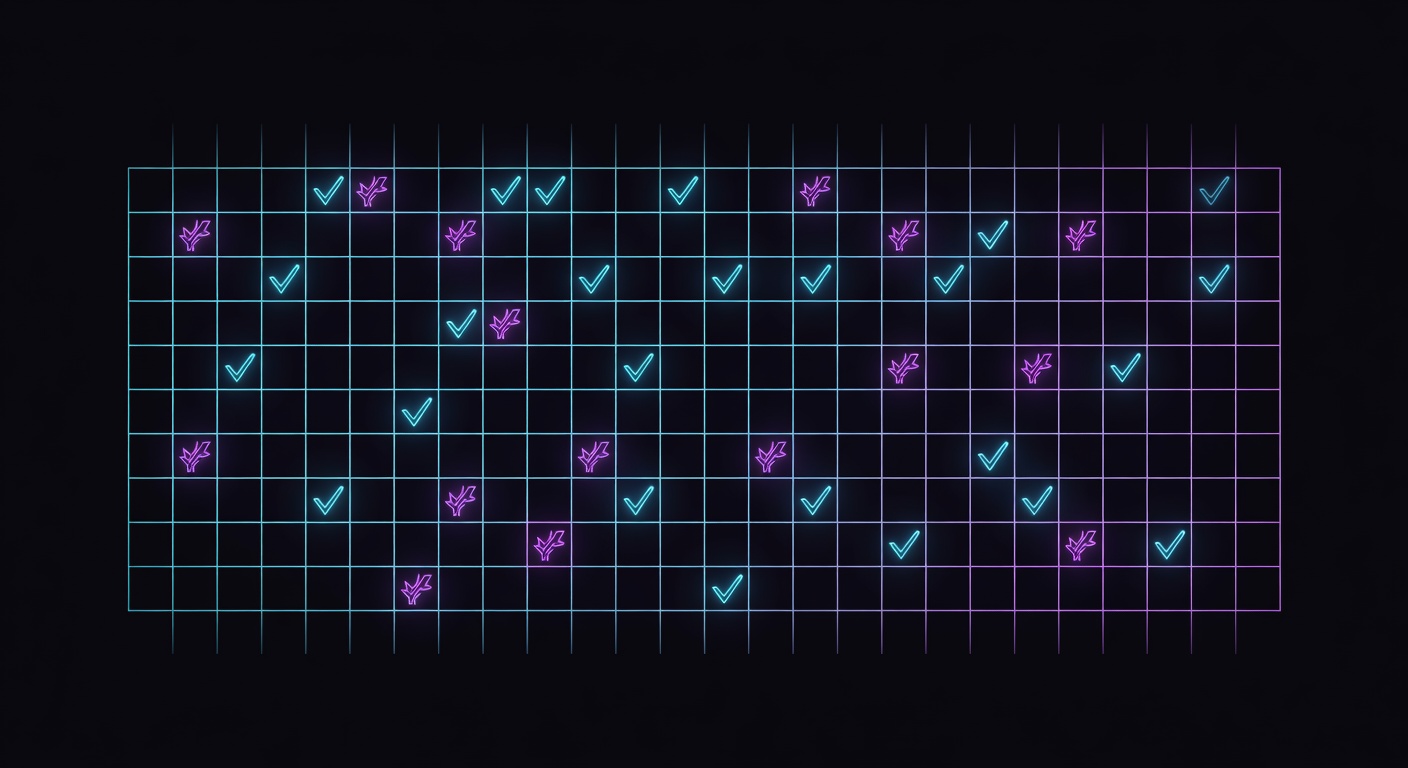
Mines is the simplest game you've ever seen. There's a grid. 25 squares. Some are safe. Some are mines. You click a square, you win money. Click a mine, you lose it all. That's the whole game.
The kid was up $8,000. Then down $5,000. Then up $12,000. The pattern was predictable. Mines creates a loop. Win a few rounds, get confident, lose it all chasing the big hit. Repeat.
Round 1: How Mines Actually Works
The game board is 5x5, so 25 squares total. At the start, you choose how many mines you want on the board. You can set 1 mine, 24 mines, anything in between. Let's say you choose 3 mines and 22 safe squares.
Your first click: the probability of hitting a safe square is 22/25 = 88%. If you hit it, you double your bet and move to the next click.
Second click: now there are 24 squares left (one revealed). Your probability is 21/24 = 87.5%. The odds get better as you reveal safe squares.
But here's the thing: one mistake ends it. You need to be right every single time. 10 clicks in a row with 3 mines means hitting 10 safe squares out of diminishing pools. The math is brutal.
Round 2: The House Edge in Mines
Stake's Mines is provably fair. They use on-chain verification and smart contracts. The RNG is transparent. You can audit it. But transparency doesn't make the odds better.
A typical Mines game with 3 mines played optimally (cashing out at the right moment) has a house edge of 1.5% to 3%, depending on your cash-out strategy. That sounds low. It's not. That's a theoretical edge assuming perfect play.
Most players don't have perfect play. They see $8,000 in winnings and want $16,000. They click again. And again. The house edge becomes 10%, then 20%, then they're broke.
Round 3: Why Mines Is Addictive
Mines creates a specific psychological loop. You're not fighting the house. You're fighting yourself. Every click is a choice. Miss one, and it's on you.
Compare this to a slot machine or Evolution's Live Roulette. There's surrender in those games. You press a button and the outcome is beyond your control. With Mines, you are the outcome. Every loss feels like you messed up.
The paradox: that feeling of control makes Mines more addictive, not less. It lets you tell yourself you can master it. You can't. The math won't let you.
Round 4: The Specific Math of Loss
Let's say you play Mines with 5 mines on the 25-square board. The safe squares are 20. You start with $100 and want to reach $1,000.
First click: 20/25 probability = 80% chance. If you win, you're at $200. If you lose, you're at $0. Second click (if you survived): 19/24 = 79.2%. Third click: 18/23 = 78.3%.
By the fifth click, you're at 16/21 = 76.2%. You need five wins in a row, each slightly less likely than the last. The probability of hitting all five is 0.80 x 0.792 x 0.783 x 0.774 x 0.762 = 0.35, or 35%.
Meanwhile, there's a 65% chance you lost everything.
Round 5: The Honest Assessment
Mines isn't a strategy game. You can't beat it. You can only delay the inevitable. Every extra click is a declining probability on a path that ends in ruin.
The kid playing at 3 AM understood the rules. He didn't understand the geometry. By the time I watched him lose that $12,000, he was fighting against math, not the casino. He was fighting against himself.
Stake is legal. It's provably fair. It's transparent. Those things are all true. But transparency doesn't make Mines less of a grind. It makes it more honest about what it is: a game where the longer you play, the more the math turns against you.