iTech Labs and GLI: A Look at Casino Testing Agencies
Casino games are tested by third-party auditors before they are deployed. iTech Labs and GLI are the two largest. Understanding what they test explains what they cannot test.

The deal
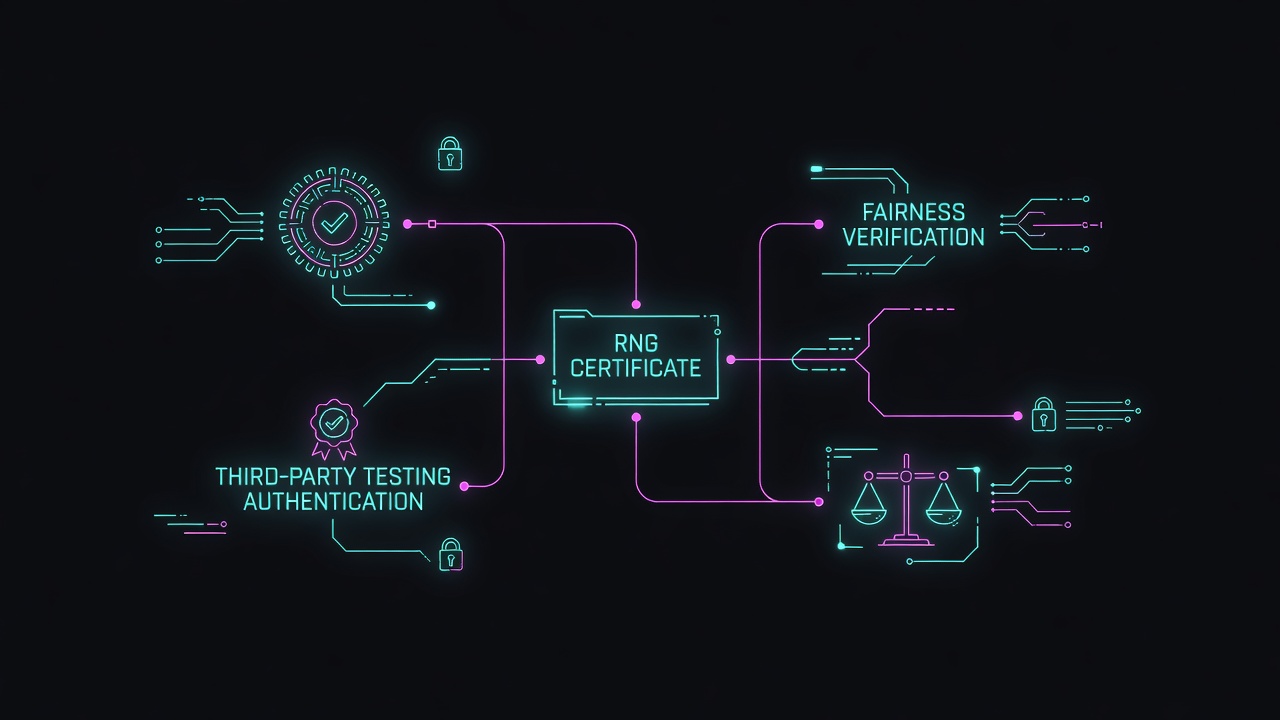
A regulation casino does not simply deploy a game and hope it is fair. The game is tested by an independent third-party auditor. This is a condition of every gaming license issued by major regulators (UKGC, MGA, New Jersey Division of Gaming Enforcement).
ITech Labs (incorporated as iTech Labs Pty Ltd) and GLI (Gaming Laboratories International) are the two largest test houses. Between them, they certify approximately 85-90% of all licensed casino games in major jurisdictions.
The testing process begins with the game's source code. The test house audits it line by line, checking for anomalies, undisclosed logic, or deviations from the declared pay table and probability distribution. This is not casual inspection. It is cryptographic verification that the code produces the exact probability distribution the operator claims.
Round 1: What Gets Tested
First: the random number generator. The RNG is the seed of all fairness in a casino game. The test house verifies that the RNG uses a cryptographically secure algorithm (typically AES or ChaCha20), that the seed is sufficiently random (usually generated from system entropy or hardware random sources), and that the output distribution is uniform across the full range.
Second: the payout distribution. The pay table (the list of payouts for each winning combination) must match the probability of landing that combination. A test house will simulate millions of hands and verify that the distribution of payouts matches the declared pay table within a confidence interval (usually 0.5% to 1%).
Third: game logic. The game must execute its rules as stated. If the game claims "you double down on any hand," but the code restricts doubling to 9-11, that is a discrepancy and the game fails testing.
Fourth: edge cases. The test house runs the game through unusual scenarios: maximum bet, minimum bet, rapid consecutive plays, simultaneous actions that should not be possible. Does the game crash? Does it enter an invalid state? These are tested.
Round 2: What Does Not Get Tested
Testing agencies do not test whether a game is fun or engaging. They do not test whether the volatility is appropriate. They do not test whether the game's design creates behavioral patterns that might be harmful to players.
They test the mechanics and the math. They do not test the experience.
This is important because it is possible to create a game that passes all testing requirements while still being designed to maximize time spent and increase behavioral addiction. A game with a 5% house edge (well within regulatory limits) will still drain money faster than a game with 1% edge. The testing does not flag the house edge as excessive; it only verifies that the edge is what the operator claims.
Round 3: The Audit Process
The full testing process for a new game can take 6-12 weeks for a simple game (like a slot machine variant) and 3-6 months for a complex game (like a live dealer game with multiple rule variations).
Once a game passes, it receives a certificate of compliance. This certificate is valid for 2-3 years, depending on the regulator. After that, the game is retested.
Updates to games trigger new testing. If an operator changes the pay table, the game must be retested. If the RNG algorithm is updated, the game must be retested. This creates a continuous compliance process.
Round 4: The Limitation
Third-party testing creates a floor of fairness, but it does not create a ceiling of consumer protection. A game can be mathematically fair (the RNG is working, the pay table is accurate) and still be psychologically exploitative. The testing verifies the math but not the mechanism.
ITech Labs and GLI are not consumer advocates. They are not evaluating whether a game should exist. They are verifying that if a game exists, it operates as claimed.
Under this framework, a game with a 7% house edge and a design that triggers rapid repetitive play is mathematically sound and therefore approvable. The testing does not flag it as predatory. It only verifies that the declared edge matches the actual edge.