RNG Certification: How Online Poker Proves Fairness
Every legitimate online poker room has their RNG (Random Number Generator) certified by a third party. This is how they prove the game is not rigged.
The deal
An RNG (Random Number Generator) is software that produces random numbers. In online poker, the RNG determines which cards are dealt, the order they are dealt in, and the shuffling of the deck.
If the RNG is biased (not truly random), the poker room can rig the game. If aces come up 2 percent more often than they should statistically, the room can control which player gets them.
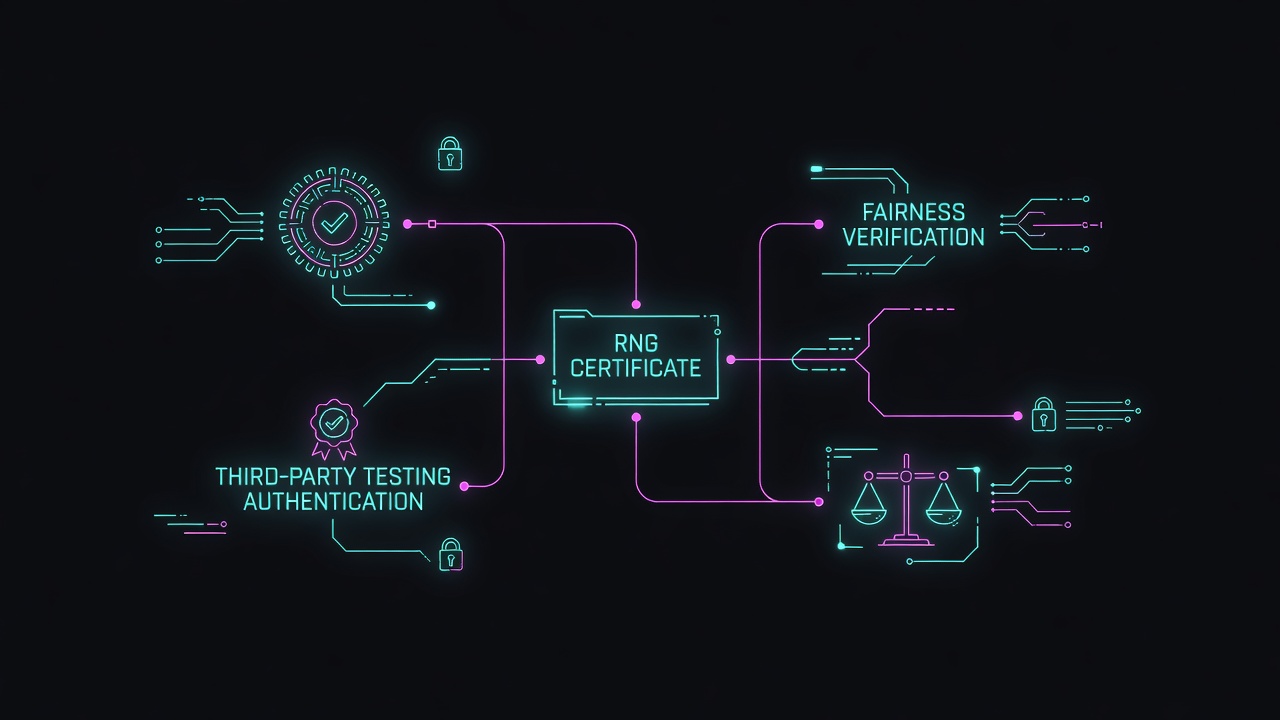
Legitimate poker rooms prevent this by hiring independent testing companies to certify their RNG.
Round 1: The Certification Process
A company like GLI-13 (Gaming Laboratory International) takes the poker room's RNG code and tests it. They run billions of simulations. They analyze the results for bias.
They look for patterns. Do certain cards appear too often. Do certain suit distributions deviate from expected distribution. Do certain player positions receive better cards than other positions.
If the RNG passes (shows no statistical bias), GLI-13 issues a certification. The poker room can then advertise that their games are GLI-13 certified.
Round 2: What This Means
A GLI-13 certification means the RNG is mathematically sound. It does not mean the poker room cannot cheat. A room could use a certified RNG in normal games and a rigged RNG in special circumstances. The certification only covers the RNG, not the entire system.
But certification dramatically reduces the likelihood of cheating because the room has voluntarily submitted to third-party auditing.
Round 3: The Regulations
Every legitimate online poker jurisdiction (UKGC, MGA, Alderney, Malta) requires RNG certification. They require specific testing companies (usually GLI, eCOGRA, or equivalent). They require annual re-certification.
Bad-actor poker rooms (Curacao license, sketchy jurisdictions) often do not publish RNG certifications because they do not have them.
Round 4: The Reality
A certified RNG means the published statistical distribution of cards is fair. But it does not mean bots cannot abuse the system. It does not mean collusion is impossible. It does not mean the room does not have inside information about your cards (which would be terrible security but not a violation of RNG certification).
RNG certification is a floor, not a ceiling. It is the minimum trust standard. But it is a meaningful minimum.
Round 5: Why This Matters
Before online poker, players had no way to verify fairness. They had to trust the casino.
Now, players can verify that the RNG is certified. This is not a perfect guarantee, but it is better than trust.
Round 6: The Poker Decision
If you are considering an online poker room, check their RNG certification. If they do not have one, do not play there. If they do have one, you have at least one layer of protection against the room directly manipulating cards.
Certification is not perfect. But the absence of certification is almost certainly a red flag.
Round 7: Summary
The key takeaway: understand the mechanics before you bet. Do not rely on intuition or feeling. Numbers drive gambling, not luck or superstition. Whether you are betting on sports, playing casino games, or managing crypto, the winners are those who understand the underlying mathematics and apply it consistently. Everyone else is just hoping.
This is not cynical. This is mathematical reality. Acceptance of this reality is the first step toward either making money or losing less money. Choose wisely.