How to Recognize Problem Gambling Signs as a Poker Player
Poker is unusual among casino games because it contains genuine skill expression. That same feature makes it harder to recognize when the game has stopped being a game and started being something else.
The deal
Poker is designed with better retention mechanics than almost any other gambling product. This is not an accident, and understanding why the design works the way it does is the first step to recognizing when it is working on you in ways you did not consent to.
Start with the skill component. Poker has genuine skill expression, meaning that better players win more often over time against weaker players. This is real. It is also the most effective retention hook in the game's design, because it gives you a narrative for every losing session: I was outplayed, I made mistakes, I can improve. That narrative is usually true. It is also the exact same narrative you tell yourself during problem gambling, where the story of "I just need to get better" replaces any honest accounting of what the game is actually costing.
Round 1: The Feedback Loop That Traps Good Players
Good poker players are more at risk in some ways than recreational players. Here is the loop:
You improve. Your win rate at your current stakes becomes positive. You move up. At higher stakes, variance is larger, session lengths are longer, and the skill differential compresses. You lose. The explanation is "I moved up too fast" or "the field is tougher here." Both may be true. Both also delay recognition that your relationship with the game has changed.
The onboarding mechanism of poker, which rewards study and improvement with real wins, trains you to treat the game as a skill development system. Skill development systems have no natural off-ramp. You don't graduate from poker. The reward schedule for improvement is variable and delayed, which is the most powerful reinforcement structure behavioural psychology has identified. The game is, from a systems perspective, optimally designed to keep skilled players playing.
Round 2: Specific Signs to Watch for in Poker Specifically
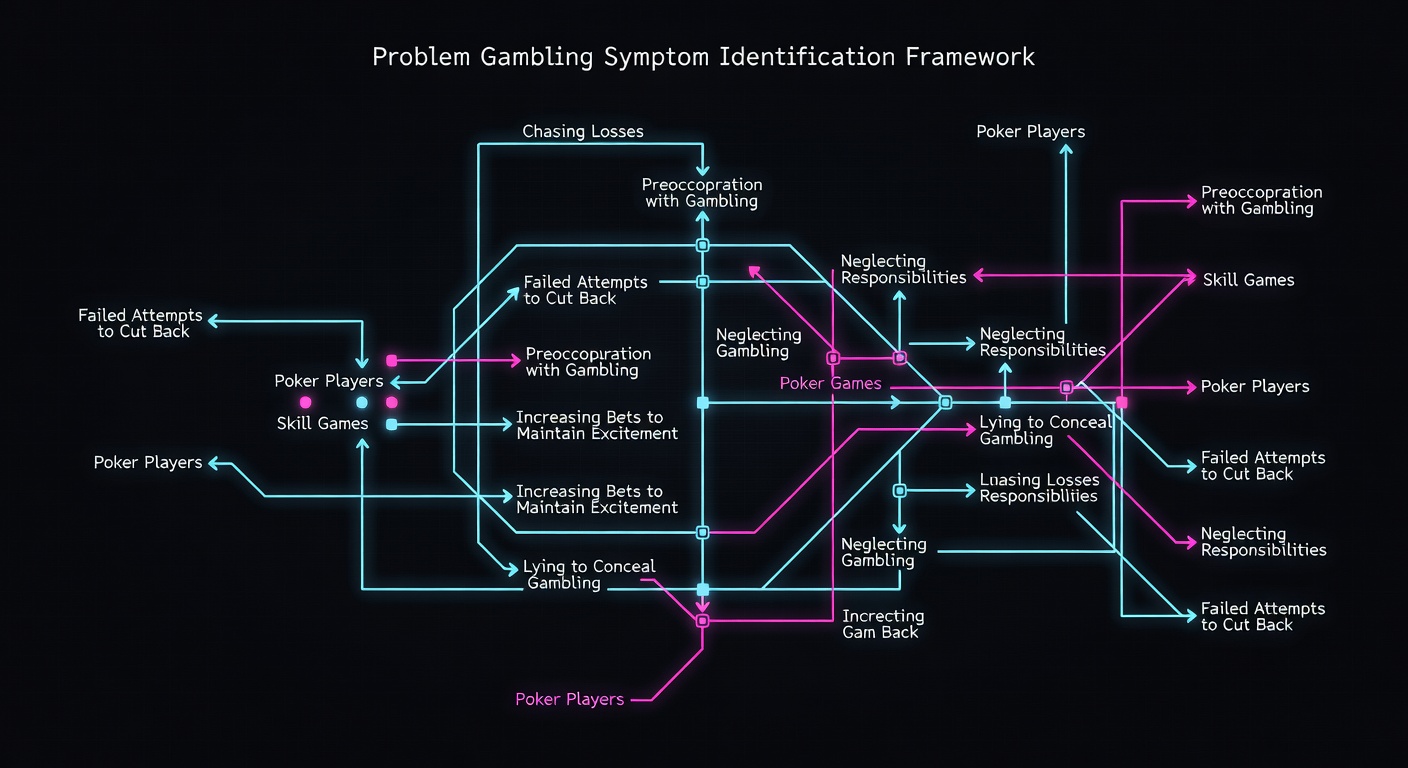
General problem gambling checklists exist, and they are useful. The following are signals specific to the poker context:
- Session length creep: You planned a two-hour session. You are still sitting after five hours because you are "stuck" and need to recover losses before leaving. This is the sunk cost fallacy running live in real time.
- Moving down in stakes to avoid quitting: You are losing at your regular stakes and drop to lower stakes not because it is strategically correct but because it lets you keep playing without technically chasing the loss at the original stake.
- Hand history review has become obsessive rather than analytical: Studying your play is healthy. Spending four hours reviewing a single bad beat at 2am trying to prove the universe was wrong is a different activity.
- Bankroll management has become theoretical: You know the correct bankroll management rules. You are not following them. You have a story about why this situation is an exception.
- Playing through physical signals: Tired, hungry, emotionally volatile. A functioning poker player books a session exit when any of these apply. If you cannot book the exit, note that.
Round 3: The Tilt Mechanic Is Designed
Tilt, the state of emotionally compromised play following bad outcomes, is not a personal weakness. It is a predictable human response to variance in a system with real money attached. Experienced poker players talk about tilt management as a skill, which it is. It is also the game's most effective mechanism for converting a previously profitable player into a losing one in a single session.
The game's feedback structure, immediate financial consequence attached to discrete decisions, is optimized to produce emotional responses. Understanding that the emotional response was predictable, not shameful, makes it easier to treat it as information rather than something to overcome by playing more hands.
Round 4: The Difference Between a Bad Run and a Problem
Bad runs are real. Downswings of 50-100 buy-ins are documented in the poker literature for players with positive long-run expected value. A player on a genuine downswing and a player with a problem can look identical from the outside, and sometimes from the inside.
The distinguishing question is not about the losses. It is about the decision-making process. Are you making decisions about when to play, at what stakes, for how long, based on criteria that exist independent of your emotional state at that moment? Or are those decisions being made by the state itself?
Organizations like GamCare and Gambling Therapy provide support that is not predicated on you quitting. The conversation is about control, not abstinence, unless abstinence is what you need. Poker forums including TwoPlusTwo have had threads on mental game and gambling problems that run for years and contain more honest self-reporting than most clinical literature.
End of story
Scenes in this story