Mobile Poker Apps: What to Look For Before Downloading
Mobile poker apps create a portable version of a game designed to trigger behavioral responses. Understanding what to look for protects against both the house advantage and the design mechanisms meant to keep you playing longer.
The deal
Poker apps present a specific challenge: unlike casino games where the house has a fixed edge, poker is a game against other players. But the app operator still profits, and the mechanisms by which they profit are designed to increase time spent in the application. Understanding this is fundamental.
When choosing a mobile poker app, consider these dimensions.
Round 1: Regulatory Status
The first filter: Is the app licensed? In the United States, this means it should be licensed by a state's gaming regulator (New Jersey Division of Gaming Enforcement, Pennsylvania Gaming Control Board, Nevada Gaming Commission). In Europe, it should be licensed by the MGA, UKGC, or an equivalent regulator. If the app claims to be legally operated but is not regulated, it is not legally operated. The claim is marketing language, not fact.
Check the app's "About" section or its website for the licensing authority and the license number. You can verify the license is genuine by contacting the regulator directly.
Round 2: Game Integrity
Poker apps are required to use random number generators (RNGs) to shuffle cards. Licensed apps have their RNG tested by third-party auditors (iTech Labs, GLI, Gaming Standards Association). The audit should be current (within the last year).
Beyond RNG integrity, look for anti-collusion measures. Poker's vulnerability is that multiple players can collude (coordinate their play) to gain an advantage over other players. Good apps use software that detects unusual patterns of play (players who fold together, bet together, win together) and investigates. Poor apps ignore this entirely.
You are playing against real humans. The operator has an incentive to ensure those humans are not secretly cooperating against you.
Round 3: Rake Structure
The operator makes money by taking a percentage (the rake) from each pot. Typical rake is 4-5% of the pot (up to a maximum) in ring games. In tournaments, the operator charges an entry fee (the buy-in) plus a fee (typically 8-10% of the buy-in), which goes to the operator, not the prize pool.
A 5% rake in a typical game is standard. A 10% rake is aggressive. A 2% rake is unusually low and signals either a loss-leader strategy (the operator is spending money to build player base) or a new room trying to attract players.
Lower rake means more money stays in the player pool, which means the game is more beatable. This matters over time. A player who can win at a 5% rake game might break even or lose at a 10% rake game, all else equal.
Round 4: Player Liquidity
You need other players at your stakes. An app with thousands of users but limited liquidity at your stakes is useless. Look at the lobby: are there games running at your preferred stakes? Are the games consistently full or are they struggling to fill?
Poker apps show lobbies publicly so you can assess this before downloading. Some apps (PokerStars, 888poker) have excellent liquidity across many stakes. Others (app-only poker operations) may have fewer players and thus fewer games.
Round 5: Behavioral Design
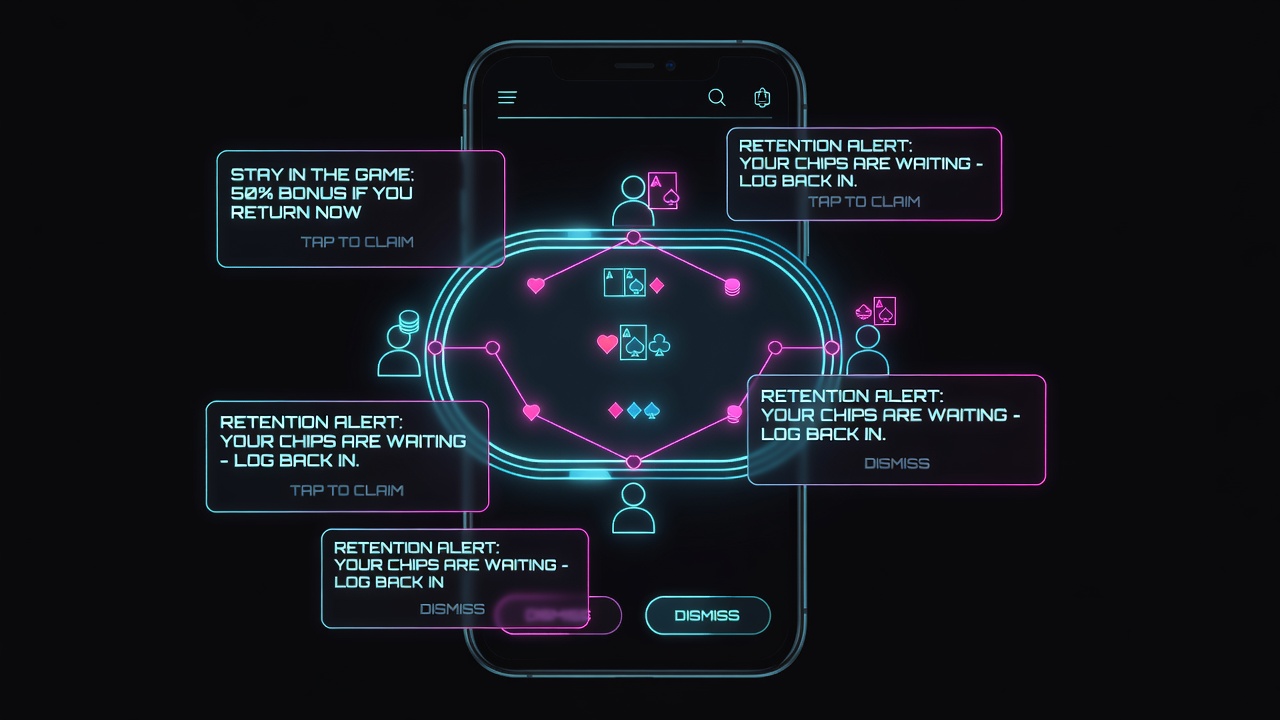
Look critically at the app's design. Does it send constant notifications urging you to play? Does it use reward systems (badges, level-ups, seasonal challenges) that encourage longer sessions? Does it have a "next game" button that automatically loads the next hand, reducing friction between decisions?
These are engagement mechanisms, and they are intentionally designed to increase time spent in the app. This is not necessarily manipulative (poker is a game that can be played responsibly), but be aware that the design is optimizing for engagement, not for your financial or time-management interests.
Round 6: Deposit and Withdrawal
Check whether the app allows deposits from your preferred payment method (credit card, debit card, PayPal, cryptocurrency, bank transfer). Check whether withdrawals are processed to the same method. If the app accepts multiple payment methods but withdraws only to cryptocurrency, that is a sign of evasiveness.
Check the withdrawal timeline. "Processed in 5 business days" is normal. "Processed in 1-2 business days" is good. "Withdrawals pending indefinite investigation" is a red flag.
Round 7: Community and Support
Are there community forums or a subreddit where players discuss the app? What are they saying? If the dominant sentiment is "I cannot withdraw" or "The support team is unresponsive," those are strong signals to avoid.
Try contacting customer support with a simple question (nothing that requires account access). How quickly do they respond? How helpful is the response? This is a proxy for how they will treat you if a problem arises.
Round 8: The Larger Context
Mobile poker is real poker against real players, but it is real poker mediated through an app whose design is optimized for engagement. The app is not neutral technology; it is a delivery mechanism that shapes behavior. Being aware of this shapes your play.