How Progressive Side Bets on Table Games Really Work
Progressive side bets look like a small extra wager against the table. In practice, they're a separate revenue stream with their own house edge, their own jackpot mechanics, and their own way of separating enthusiastic players from their money faster than the main game does.
The deal
I watched a woman hit the royal flush side bet on a Three Card Poker table at the MGM Grand in 1994. Progressive had been seeding for about eleven months. She won something north of ninety thousand dollars. She had put up a dollar extra. The table applauded. She cried. The pit boss congratulated her and then radioed the eye-in-the-sky, because that's what you do.
Everybody goes home with the story of the woman who won ninety grand on a dollar. Nobody goes home with the story of the thousand people who put up a dollar on that table in the preceding weeks and got nothing.
That's the architecture of the progressive side bet, and it's worth understanding.
Round 1: The Two Pools
When a player places a side bet on a table game, they're entering a pool that is entirely separate from the main game. The main game has its own house edge. Three Card Poker's Pair Plus bet runs around 7.3 percent for the operator. Blackjack's main hand, with basic strategy, holds the house to somewhere between 0.5 and 1.5 percent depending on the ruleset.
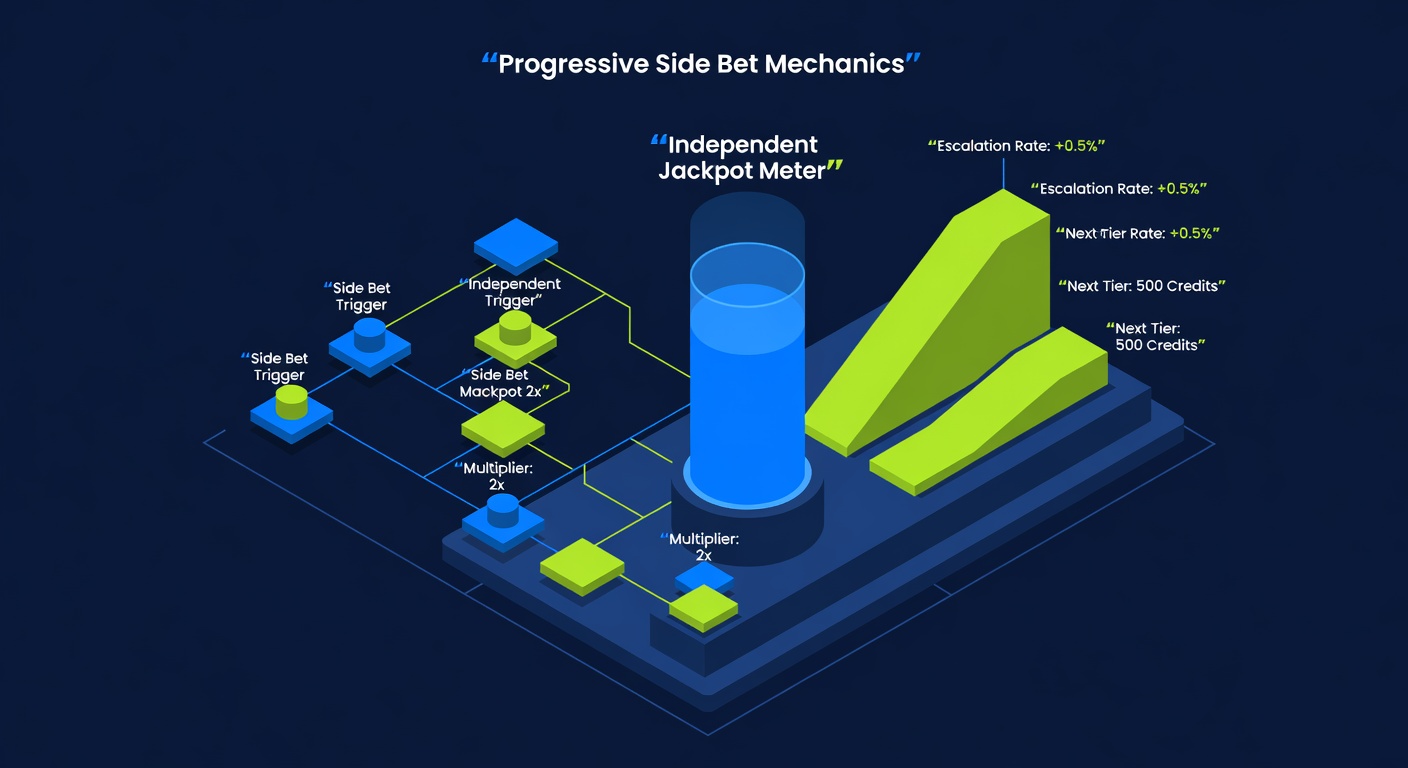
The progressive side bet sits on top. The house edge on progressive side bets typically ranges from 15 to 30 percent, sometimes higher when the jackpot is freshly reset. That's not a typo. In exchange for that enormous rake, the operator feeds a portion of every dollar into the jackpot pool.
The reset value matters. Most progressives start at a published seed, say ten thousand or twenty-five thousand dollars. After a hit, the meter resets to that seed. When the jackpot is sitting at the seed, the house edge is highest. As the meter climbs, the math gradually improves, because the expected value of the rare top payout increases. At some theoretical break-even point, the progressive is actually offering positive expected value. That point is usually far enough out that almost nobody waits for it, and the operators know this.
Round 2: Linked vs. Local
There's a distinction players often miss. Some progressives are local, meaning they build from a single table or a handful of tables in one property. Others are networked, meaning they're linked across dozens or hundreds of casinos.
Mindway's Caribbean Stud progressive was one of the early networked versions, sharing a jackpot pool across multiple properties. Shuffle Master, which eventually became Scientific Games, built a significant business licensing progressive side bet mechanics to properties that didn't want to manage the jackpot infrastructure themselves.
Networked progressives grow faster, hit larger, and reset more cleanly when they do hit. The chance of any individual player hitting a networked jackpot is also considerably lower, because you're competing against a much larger pool. The posted odds on most progressive paytables don't distinguish clearly between local and networked exposure, and not every floor supervisor can explain it either.
Round 3: What the Eye Sees
Surveillance watches progressive tables closely. Not for cheating, primarily, though collusion on a progressive is a known attack vector. The eye watches because a jackpot hit is a moment of significant financial exposure for the property.
The hit is validated, the hand is reconstructed from camera footage, the dealing procedure is reviewed. RNG certification matters here too. Online progressive side bets run through certified RNG systems, typically tested by labs like eCOGRA or Gaming Laboratories International, and any certified payout above a certain threshold triggers a similar review process, just automated.
When it all checks out, the money gets paid. Most of the time it checks out.
Round 4: The Whale Who Never Plays the Side Bet
High rollers, actual high rollers, rarely touch progressive side bets. Whales playing six figures a session at baccarat don't put a dollar on the insurance bet. They understand expected value in a way that makes the 25 percent house edge on a progressive feel like a personal insult.
The progressive side bet is engineered for the recreational player who finds the idea of a life-changing jackpot more compelling than the mathematics. That's a completely legitimate preference. The mathematics will not comfort you when the jackpot hits.
The woman with the ninety thousand dollars didn't care about the house edge. She cared that her dollar had become ninety thousand dollars. That's a real thing that happened to a real person. The two facts exist together without contradiction.