Blackjack Surrender Rule: When to Use It and When to Skip It
The surrender option in blackjack is one of the few player-favourable rules in the game, which perhaps explains why so many casinos either omit it entirely or bury it in fine print.
The deal
The surrender option in blackjack permits a player, after seeing their initial two cards and the dealer's upcard, to fold the hand and recover half their stake. The remaining half goes to the house. It is, in the arithmetic of the game, a precise instrument: correctly applied, it reduces the house edge by approximately 0.07 to 0.09 percent depending on the specific rule set. Incorrectly applied, or never applied at all, it contributes nothing.
The rule appears in two forms. Late surrender, which is the version you will encounter at most casinos offering the option, permits folding only after the dealer has checked for a natural blackjack. If the dealer has blackjack, the hand ends immediately and surrender is irrelevant. Early surrender, which is vanishingly rare in contemporary casino environments, permits folding before the dealer checks, making it considerably more valuable and considerably less likely to appear on a felt near you.
Round 1: The Basic Strategy Cases for Surrender
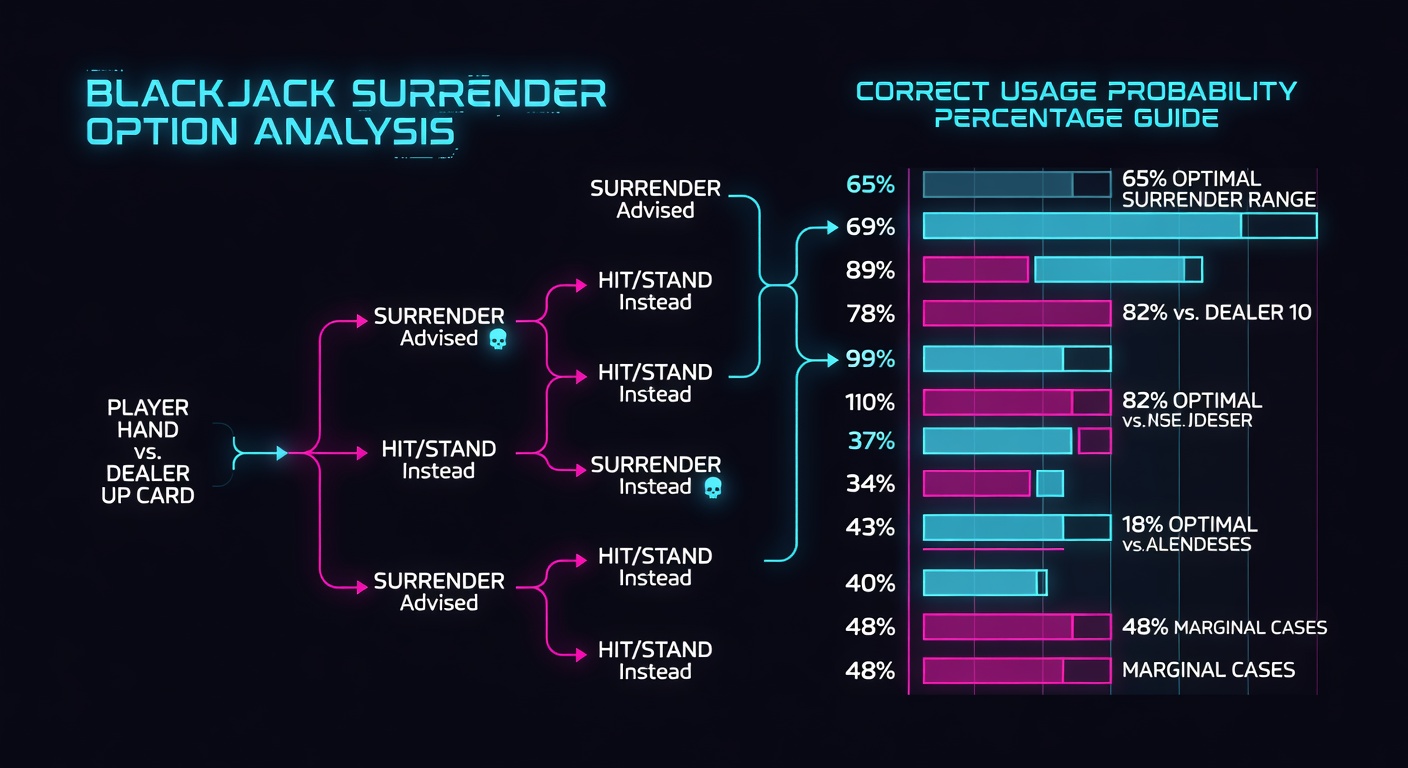
Basic strategy for late surrender, based on a standard six-deck game where the dealer stands on soft 17, identifies a small number of specific hands where surrendering is mathematically correct. These are not optional enhancements. They are correct plays with negative-expectation alternatives.
- Hard 16 against dealer 9, 10, or Ace: The combination of a stiff hand against a strong upcard creates an expected loss, per hand, that exceeds 50 cents on the dollar if played. Surrendering recovers half the bet, which performs better than any alternative.
- Hard 15 against dealer 10: The same logic applies in most shoe games. The expected loss by playing is worse than the guaranteed 50-cent cost of surrendering.
- Hard 17 against dealer Ace (in some specific rule configurations where the dealer hits soft 17): This case is less universal and depends on the specific rules at the table.
The pair of 8s versus dealer Ace is a point of genuine debate in the strategy literature. Most standard basic strategy charts recommend splitting 8s always, including against an Ace. Some experienced players surrender here instead, reasoning that splitting into two bad hands against the strongest dealer upcard is worse than cutting losses. The expected value difference is small, under 0.01% per hand, which is to say that either decision is defensible but the commitment to consistency matters more than the specific choice.
Round 2: Why Casinos Manage the Rule So Carefully
The surrender rule, available and properly used, costs the house somewhere between 0.07 and 0.09 percent. This is a small number. It nevertheless represents real money at volume, which explains the rule's peculiar history of appearing and disappearing from casino floors.
Las Vegas properties have offered surrender intermittently since the 1970s. The rule tends to appear at higher-limit tables, where it functions as a player amenity, and tends to be absent from lower-limit and mid-stakes games where the house calculates the edge matters more. Single-deck games rarely offer surrender. Multi-deck shoe games are more likely to include it, partly because the overall conditions in shoe games are already worse for the player.
Online casinos present an interesting case. Because the marginal cost of offering any rule variant is zero, the decision about surrender is purely a product design choice. Several major online providers include late surrender across their blackjack variants; others do not. The presence or absence of the rule is listed in the game's rules panel, though with varying clarity.
Round 3: What the Rule Does Not Do
Surrender does not rescue a poor session. It does not compensate for incorrect play on other hands. A player who surrenders correctly in every applicable spot but makes fundamental errors elsewhere, standing on 12 against a dealer 7, failing to double 11 against small upcards, is still playing with a larger house edge than the rule's correct application would imply.
The surrender rule is also not available after taking additional cards. A player who hits a hard 16, receives another card, and then finds themselves with a difficult total cannot retrospectively surrender. The option exists only on the initial two-card hand.
The discipline required to surrender a hand, particularly an 8-8 against an Ace when the instinct is either to fight or to salvage something by splitting, is the same discipline required throughout the game. The player who folds correctly when folding is right is generally the same player who doubles correctly when doubling is right and splits correctly when splitting is right. These decisions form a coherent approach rather than a collection of isolated choices.