How to Track Your Poker Results Like a Pro
Serious poker players keep meticulous records not from obsession but from necessity. The records are the only way to know whether you are genuinely skilled or simply lucky.
The deal
One distinguishes the amateur poker player from the professional by observing a single behaviour: the professional keeps records. Not a casual note of the day's results, but a systematic log of every session, every hand of consequence, every decision made and its outcome relative to the decision that was theoretically correct. The amateur plays and forgets. The professional plays and documents.
This distinction is not new. Professional card players have kept records since the 1960s, when the first cohort of serious advantage players began documenting their sessions. The purpose then, as now, is to answer a deceptively simple question: Am I winning?
Variance in poker is extraordinary. A player can play perfectly for an entire week and still lose money. Randomness obscures skill. Only across sufficient volume does skill emerge. The professional tracking system is a mechanism for separating signal from noise.
Round 1: The Baseline: What to Track
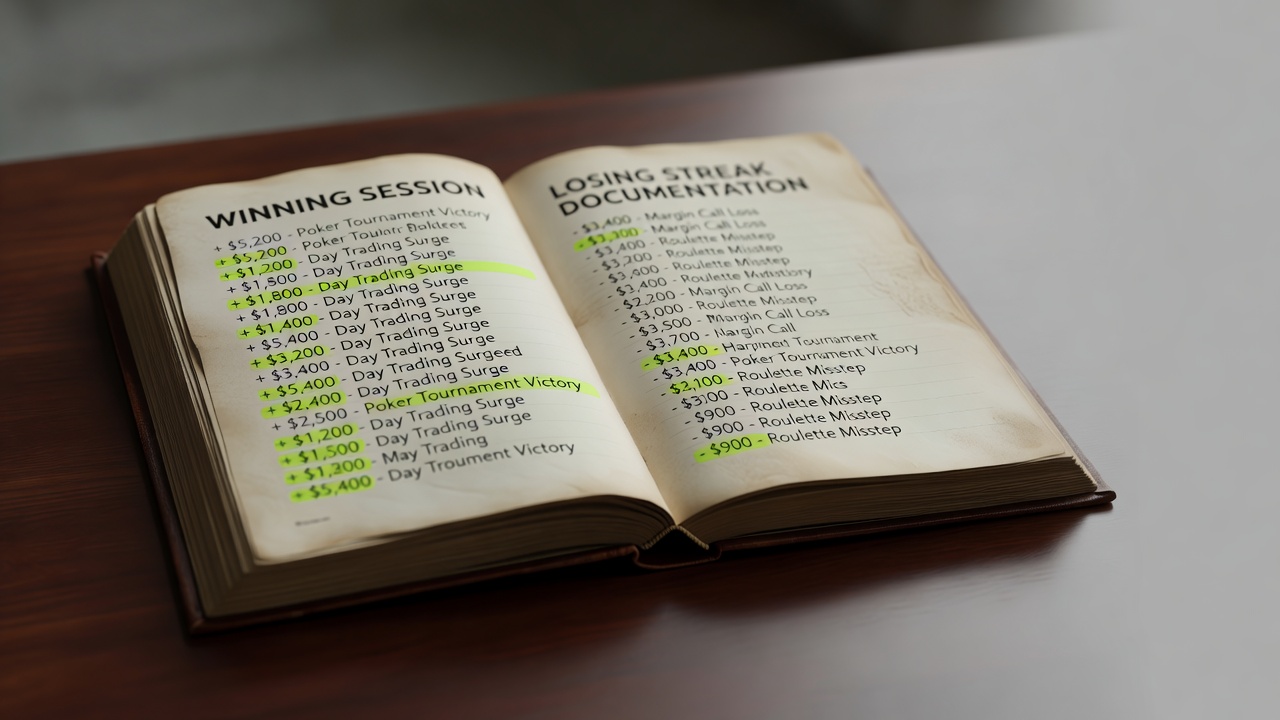
At minimum, one should record: the date, the time, the venue (casino or app), the game (No-Limit Hold'em, Pot-Limit Omaha, etc.), the stakes, the buy-in amount, the cash-out amount, and the net profit or loss. One spreadsheet, one row per session, completed the moment one leaves the game. This takes thirty seconds and provides the foundational data.
Software packages like PokerTracker and Hold'em Manager automate much of this for online play, importing hand histories directly from platforms. For live play, manual entry is necessary.
Round 2: The Intermediate Level: Hand-Level Data
Once one is tracking sessions regularly, the next refinement is tracking significant hands. This requires recording the following for each hand: the position, the hole cards, the action pre-flop, the action on each street, the outcome, and (crucially) whether the decision made was the correct theoretical decision.
This last point is the hinge. A player who lost money on a hand but made the theoretically correct decision is making progress, even if the result was negative. A player who won money but made the theoretically incorrect decision is actually losing money; they are simply benefiting from randomness. The long-term loser who continued to improve their decision-making is more skilled than the short-term winner making poor decisions.
Tracking at this level requires either significant manual effort or software that integrates with your game. For online poker, software handles it automatically. For live poker, one must either video-record sessions (if the venue permits) or trust memory and notes taken immediately after the hand.
Round 3: The Advanced Level: Closing Line Value and Winrate
The most sophisticated players track "closing line value" (CLV): the difference between the odds they got when they committed money versus the odds they would get if placing the same bet at the end of the hand. If you bet $20 into a pot of $30 (getting 2.5-to-1 odds) and then the hand plays out such that you would only get 1.5-to-1 odds by the end, you paid too much for the opportunity. You had negative CLV.
CLV is not about whether you won or lost the hand; it is about whether you made a mathematically sound decision given the information available at the time you made it. Tracking CLV across thousands of hands reveals whether your pre-flop and post-flop decision-making is sound.
Winrate (dollars won per hour of play, or dollars won per 100 hands) is the metric that matters. A break-even session is a session where you neither won nor lost significantly. A $50 winrate over 1,000 hands (typically 20-25 hours of live play) is excellent. $20 per hour is solid. Break-even is where most amateur players live.
Round 4: The Psychological Component
Tracking systems serve a psychological function beyond data collection. They create accountability. A player who knows that every session will be recorded and analysed is more likely to play disciplined poker, stick to bankroll management, and avoid tilting. The act of recording forces you to confront your results directly.
Furthermore, a genuine losing player who tracks religiously will eventually see the pattern in the data. You cannot deny a spreadsheet that shows losses across 100 sessions. This is the value of tracking for the player who is struggling: it provides clarity. You can then either improve your game or accept that poker at your current level is not a profitable activity for you.
Round 5: The Implementation
For live poker: a simple Google Sheets or Excel spreadsheet with columns for date, venue, game, stakes, buy-in, cash-out, result, and notes. Update immediately after each session. Review monthly to calculate winrate. Every six months, review to identify patterns.
For online poker: use PokerTracker (the industry standard) or Hold'em Manager. Both integrate directly with poker sites and automatically import your hand histories. The software calculates winrate, position-based statistics, and all the metrics a serious player needs.
The tracking itself is not what makes a player profitable. The tracking is the mirror. The mirror shows you whether you are actually skilled or simply alternating between lucky and unlucky runs. Professional poker requires that mirror.