How Online Poker Sites Keep Games Fair
Your first night on a poker site, you get AA three times in 40 hands. It seems rigged. Statistically, you just got lucky. But how do you actually verify that the site is not cheating?
The deal
The question everyone asks: how do I know the game is not rigged?
The answer: you do not know. But you can check.
Round 1: The RNG
Online poker depends on a random number generator. A mathematical algorithm that produces a sequence that, for practical purposes, appears random. No algorithm is truly random, but they can be random enough that human behavior cannot predict them.
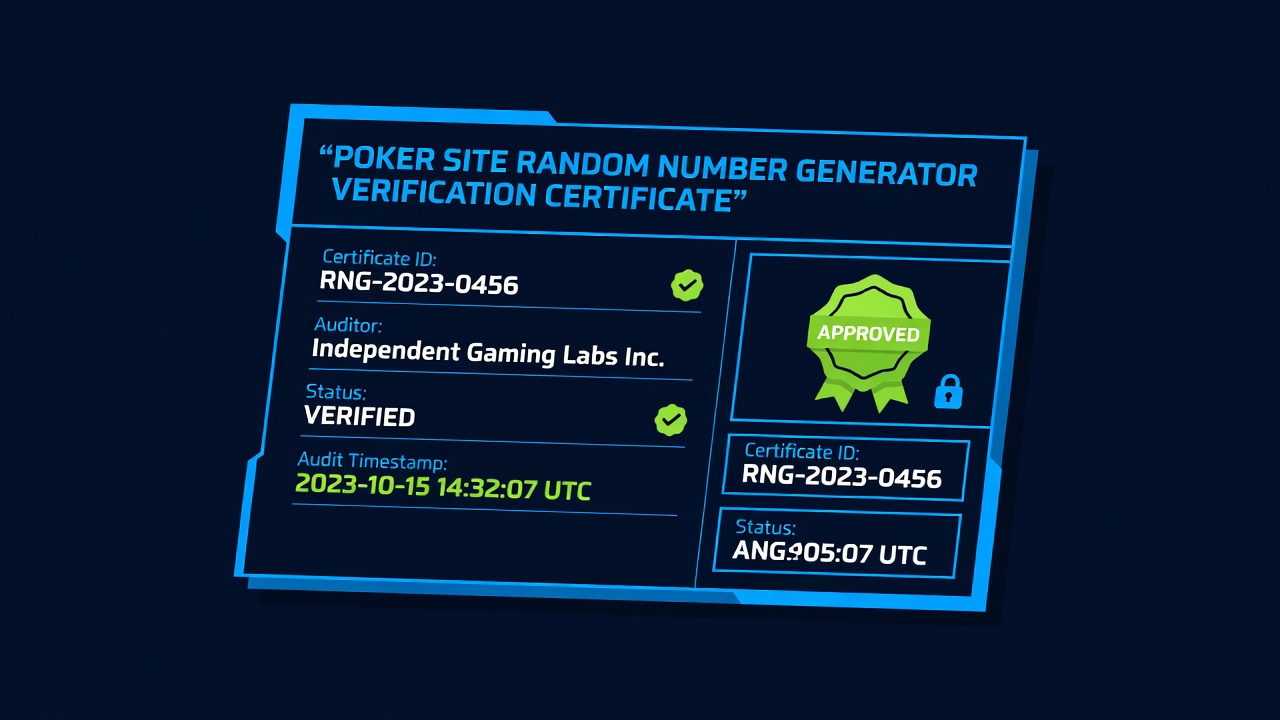
Licensed poker sites are required to use certified RNGs. The certification comes from third parties: Gaming Laboratories International (GLI), eCOGRA, independent auditors.
These auditors test the RNG by running millions of hands through it and checking the distribution. Do aces appear too frequently? Do specific positions win too often? The tests are statistical, looking for patterns that should not exist.
If the RNG passes, the site is using a genuinely random (or sufficiently random) mechanism for dealing cards.
Round 2: Shuffling
Once cards are randomly generated, they need to be shuffled. The shuffle algorithm is also tested. The requirement is that every possible shuffle order should be equally likely.
A bad shuffle algorithm might favor certain orderings (aces together, for example). A tested shuffle ensures this does not happen.
The combination of RNG plus shuffle plus card distribution should produce games that are statistically indistinguishable from a live casino deal.
Round 3: Game Integrity Monitoring
Sites monitor for collusion. Multiple players working together to cheat. This happens occasionally and is what sites are actually watching for.
The monitoring works like this: players A, B, and C play together frequently. They have a win rate that is suspiciously high. The site runs statistics: what is the probability that three players would have this specific win rate while colluding?
If the probability is very low, the site investigates. They examine hand histories. Do the players make plays that make sense only if they know each other's cards? Do they fold to each other unusually often?
If collusion is detected, the site bans the accounts and returns the victims' money (if possible).
Round 4: Can the Site Cheat You?
Yes, technically. A site could install a rigged RNG. They could install a "bad beat monitor" that ensures popular players win or lose on a schedule. They could do many things.
But: a rigged game is eventually obvious. Over thousands of hands, statistical anomalies emerge. If the site is favoring winning players, the distribution will show it. If the site is punishing certain hand types, the data will show it.
Moreover, licensed sites are audited regularly. An auditor can request the complete RNG code, the complete hand history database, and run independent tests. If the site is cheating, it will be caught.
Round 5: So How Do I Know?
Three answers:
-
If the site is licensed by a reputable regulator (UKGC, MGA, eGaming Malta), they have been audited and passed. That is meaningful.
-
If you have experienced unusual statistical outcomes, that is not evidence of cheating. Unusual outcomes happen. In a year of playing, you will experience moments that feel rigged. That is variance.
-
If you want certainty, you do not get it. You can only select sites that are regulated and audited. Then you have to trust the process.
No site can prove they are not cheating. They can only show they have been audited by independent third parties. That is the best guarantee available.