How to Handicap MMA Fights by Style Matchups: A Bookie's Guide
I booked MMA odds for fifteen years. The key to reading a matchup is understanding style. Who pressures? Who evades? Who gasses? These tell you what happens in round three.
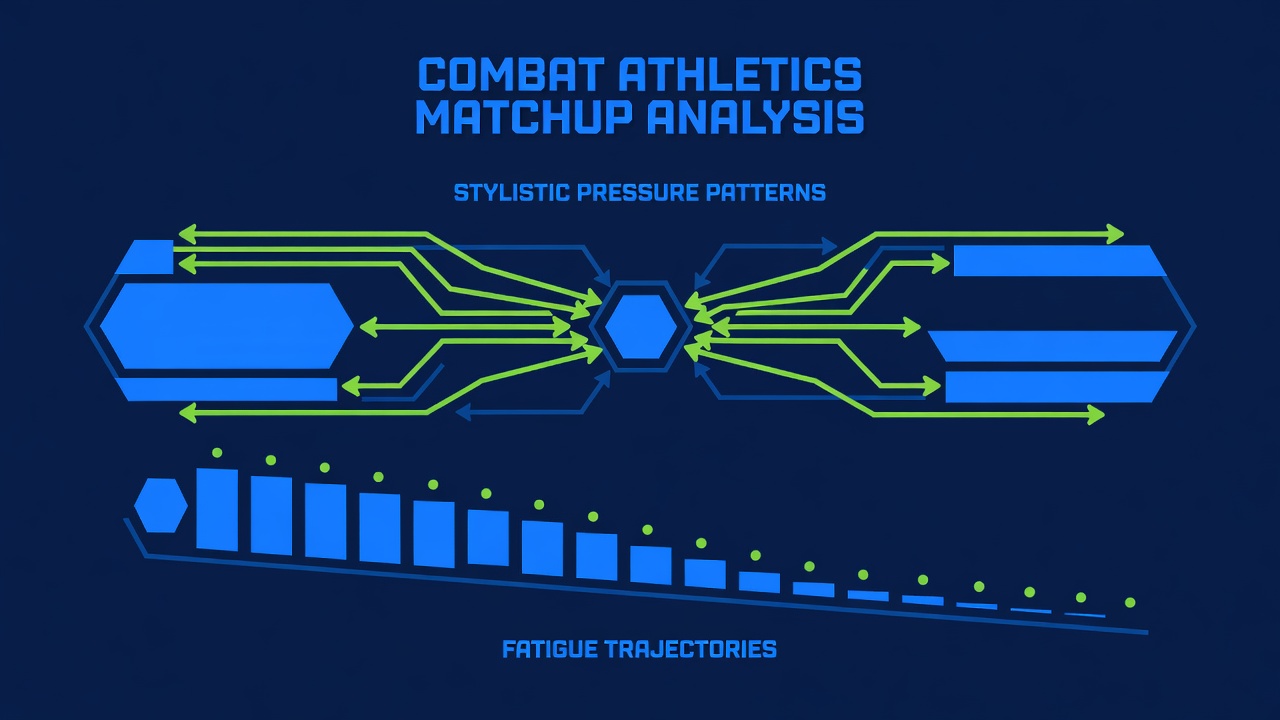
The deal
I set odds on MMA fights for fifteen years. The arithmetic is easy. The hard part is seeing what is coming. You watch fighter A and fighter B in their previous bouts and you ask: what does A do well, what does B do poorly, and what happens when those two things collide?
That is the whole game.
Round 1: The Pressure Fighter vs The Mover
MMA has a fundamental tension. Pressure fighters move forward, break the opponent's will, impose their game. Movement fighters backpedal, circle, pick their shots. Neither is inherently superior. But the matchup determines the outcome.
A pressure fighter who swarms forward works well against slow, flat-footed opponents. They do poorly against fighters who circle laterally. A movement fighter beats pressure fighters who lack cardio or lateral agility. A movement fighter struggles against long strikers with reach who can cut off the cage.
Look at the opponent's last three fights. Does fighter A face pressure well? Did the pressure fighter in that bout wilt in round three? If so, your pressure fighter might gas out here too.
Round 2: Grappling Architecture
Takedown defense is not binary. Some fighters defend by anticipation: they see the setup and adjust before contact. Others defend by scramble: they take contact and get up quickly. Neither is better. But they respond to different approaches.
A wrestler who relies on explosive power might struggle against a grappler who uses heavy inside control. A scrambler might control a wrestler who cannot maintain clinch pressure. The architecture matters.
Watch how fighter B escaped from top position in their last bout. Did they pop out quick? Did it take the opponent heavy weight and time to control them? Now imagine your fighter (the grappler) imposing their style on that.
Round 3: The Reach and Timing Factor
Reach matters more in MMA than boxing because of elbows and kicks. A fighter with a four-inch reach advantage against a shorter opponent can land from distance and move out before the short fighter closes. The short fighter needs to close aggressively, which burns energy and leaves them open to knees, elbows, and footwork.
Timing matters because of the variety. A fighter who telegraphs their strikes (wind-up) dies against someone with footwork. A fighter who throws naked combinations without setting them up takes jabs from range and defensive movements.
Look at how each fighter times their entries. Does fighter A close distance in patterns the opponent can anticipate? Does fighter B move laterally or does fighter B stand and trade? The mismatch creates the edge.
Round 4: Cardio and Volume
Round three is where fights are made. By round three, everyone has thrown combinations. The question is: who has gas left and who is breathing hard?
A fighter with superior cardio who faces a slower starter wins round three. A fighter with decent cardio who faces a guy who explodes hard for five minutes and gasses works if they can survive round one.
Look at the pace. Was fighter A's opponent dropping their hands by round two? Was fighter B's last opponent aggressive and fresh in round three? Cardio is trainable but it is also honest. It reveals itself in footage.
Round 5: The Clinic Spot
Sometimes a stylistic mismatch is so severe that one fighter simply clinics the other. I saw this with Anderson Silva against certain opponents: he was moving, countering, the opponent looked completely outmatched. The line should have been 5 to 1 in Silva's favor, but the public bet the other guy.
Identify these spots. Fighter A has fought similar styles to fighter B and won easily. Fighter B has no answer for what fighter A does. The line comes in competitive because the public sees names, not matchups. You see the matchup.
Round 6: The Reverse Spot
Also: sometimes a fighter is overvalued because they dominated a lower-ranked opponent but now face someone with different tools. Fighter C dominated fighter D (a wrestler) and the public assumes fighter C is strong. Now fighter C faces fighter E (a movement striker). Fighter E has spent their whole career circling and picking off wrestlers. Fighter C gets picked apart.
The public sees: C beat D. Therefore C is good. You see: C's style loses to E's style. Therefore E has an edge. The line is tight because the matchup is not obvious from the records.
Round 7: Reading a Mismatch
A true mismatch:
- Fighter A's style directly counters Fighter B's style
- Fighter A has fought similar opponents recently and won
- Fighter B has no stylistic tools to address Fighter A's game
- The bookmaker or public has not yet accounted for the mismatch
When you see this, you have an edge. The public is betting on fighter, not matchup. You are betting on the fight itself.
Round 8: The Uncertainty
I booked MMA for fifteen years and I was wrong often. A fighter's cardio drops suddenly. A fighter who was predictable adjusts. A younger fighter learns and improves. The matchup analysis assumes both fighters are static. They are not.
But the odds market assumes the same thing. So if your analysis is right more often than the market is, you print money. If your analysis is right 55% of the time and the odds give you 55% expected value, you break even. If the odds are loose (they give you 58% value) and you are right 55% of the time, you win over a long sample.
The key is: do your matchup analysis before you see the line. See what you think. Then check what the market thinks. If they disagree, you have an idea worth testing.