How to Handicap Tennis Matches on Different Court Surfaces
This one time at a bar in Atlantic City, I watched a guy make eight thousand dollars in two weeks because he understood clay courts. Let me tell you about his system.
The deal
I was at this dive bar near the boardwalk, the kind of place where people still smoke indoors and the bartender doesn't ask questions. A guy sits down next to me, orders a Budweiser, and says he's been making money on tennis. I thought he was full of it. I said so. He didn't get offended. He just smiled and said, "You want to hear why clay is different?"
Turns out, this guy had been a semi-pro tennis player back in the 80s. Not good enough to make a living at it, but good enough to know something. Real good enough.
Tennis, he explained, is not the same game on different surfaces. And the betting markets don't adjust for that as much as they should.
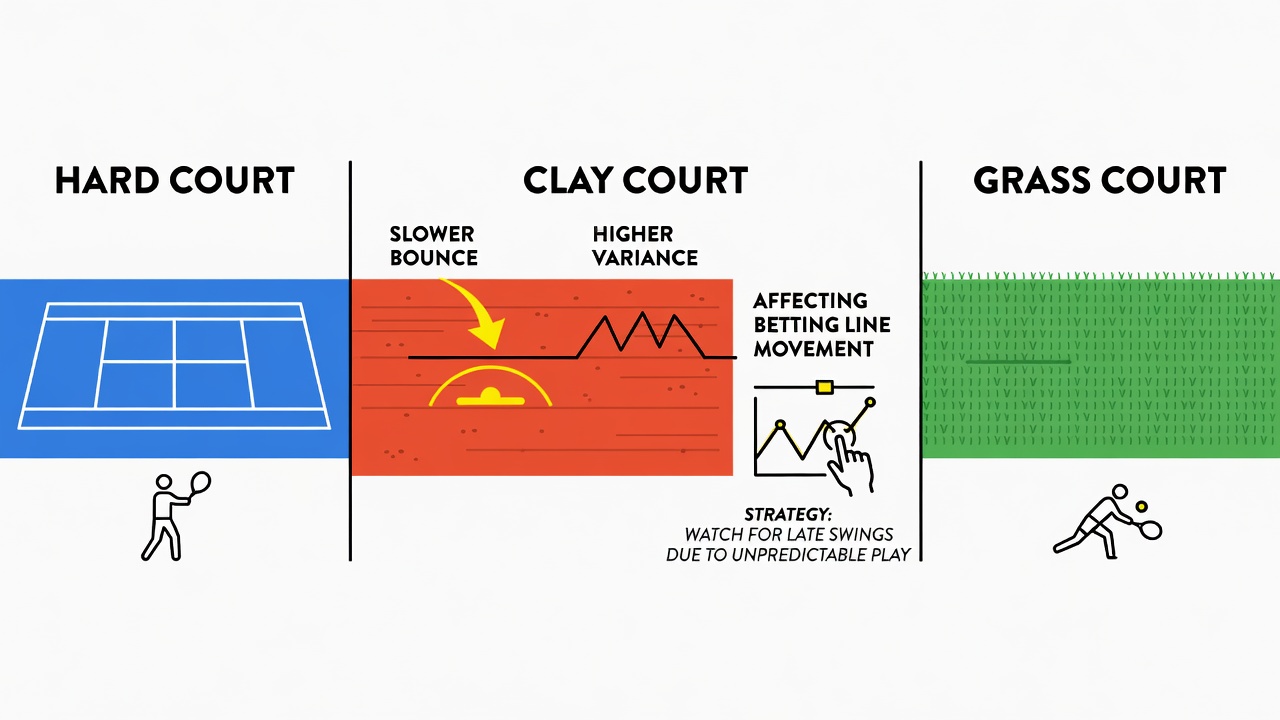
Grass court. Wimbledon type surface. The ball is fast, very fast. It doesn't bounce high. The serve is everything. A player with a 120-mile-per-hour serve has a massive advantage on grass. The baseline game dies. You need to attack the net. You need to hit through the court. The match is short. Fast points.
Hard court. Australian Open, US Open, most of the ATP circuit. Medium-paced. The bounce is predictable. The conditions are consistent because the surface is made. Both serve and groundstroke matter equally. This is where most tennis players are best because most play on hard courts as kids.
Clay court. French Open. This is where the story begins.
Round 1: Why Clay Changes Everything
Clay is slow. The ball dies when it lands. The bounce is high. The surface moves under your feet if you're not careful. The rally extends. The baseline game comes back. The server's advantage drops dramatically.
A 120-mile-per-hour serve is still a 120-mile-per-hour serve, but on clay it sits up higher. Your opponent gets more time to see it, more time to react. The return of serve matters way more on clay than on hard court.
Jump to 2022, the Roland Garros seedings. A top-ten hard court player who's a mediocre clay player can be a -200 favorite based on their ranking. But if you know tennis, if you've watched them play clay, you know they're going to lose to a clay specialist. The market hasn't adjusted. You're looking at a player seeded 30 who's actually the better clay player. Their odds are +150. That's free money if you take the time to understand the surface.
The guy at the bar called it "draw fishing." You look at the bracket, you find the clay specialist playing the hard court guy, you take the underdog. He did this for eight straight matches during the French Open. Got six of them. Didn't need to get all eight. Six is plenty.
Round 2: The Speed of the Game
On grass, a point lasts maybe five shots. On hard court, maybe eight to twelve. On clay, you're looking at fifteen to thirty. The exhaustion factor changes. A player who can sprint is better on grass. A player with endurance is better on clay. A player who can win the mental battle over three hours is better on clay.
Physics matters here too. Grass has less traction. Hard court has consistent traction. Clay has maximum friction, which means the physical demands on your legs are insane. Different shoes, different conditioning, different experience.
The bettor who doesn't think about this is leaving money on the table.
What was crazy was the guy had kept detailed notes. Spreadsheets, really. Player names, surfaces, results, notes on their play style. He knew Nadal on clay was not the same player as Nadal on hard court. Nobody's shocked by that anymore, but back when he was building his system, that was insight.
When he was done telling me about it, I said, "So you're telling me you just bet against clay-court haters when they play clay?"
He said, "Mostly, yes. But you have to watch them play first. You have to see if they've improved. Surfaces change over time. They maintained clay slower in 2015 than they did in 2018. You have to keep learning."
I never ran into him again after that night. But every French Open I find myself thinking about clay court specialists and hard court stars, and I start looking at the odds differently. Still haven't had the guts to bet on it seriously, but the logic stuck with me.