How Data Providers Power Modern Sportsbooks
Behind every live odds update and in-play market sits a small army of data engineers, satellite dishes, and feed contracts that most bettors never think about. The technology connecting a Thursday-night football match to your phone screen is more tangled, and more consequential, than any tipster would admit.
The deal
Somewhere in suburban Vienna, in a building that looks like an insurance office, a team of around forty scouts watches live sport on a bank of monitors and types what they see into a proprietary data-entry system roughly 400 times per hour. This is Sportradar's scout network at work. The scouts are the bottom layer of a supply chain that eventually produces the odds you see on Bet365, DraftKings, or Unibet before you have had time to finish your pre-match pint.
The data industry feeding modern sportsbooks is worth over USD 2 billion annually and is growing at roughly 12 percent year-on-year, according to industry estimates from 2023. Three companies sit at the top of the pile: Sportradar, Genius Sports, and Stats Perform. Each has signed multi-year exclusivity deals directly with leagues, which is where the real power lies.
Round 1: The Feed War Nobody Talks About
In 2019, the NFL signed an official data deal with Sportradar and Genius Sports worth a reported USD 1 billion over several years. What that meant in practice: only those two companies could sell NFL data carrying the league's official imprimatur. Sportsbooks that want to offer in-play markets on NFL games, the kind where the spread adjusts in real time on every snap, need that official feed. They cannot build it themselves. They cannot reliably scrape it. They pay.
Genius Sports took the NFL exclusivity one step further in 2021 by becoming the sole authorised distributor of official NFL data for betting purposes in the United States. That single contract effectively locked competitors out of the fastest-growing legal betting market in the world.
This matters to bettors because exclusivity shapes what you see on the screen. Official feeds include player-tracking data, Next Gen Stats positional data, and verified injury-timeout information. That is why in-play NFL markets on authorised operators are tight and fast. An unauthorised book relying on a secondary feed, or worse, a broadcast delay, will hang fire on prices or simply close the market whenever anything complicated happens.
Round 2: How a Bet Gets Priced in Real Time
The workflow from stadium to odds goes roughly like this:
- Scout or automated sensor captures an event (a foul, a goal, a timeout).
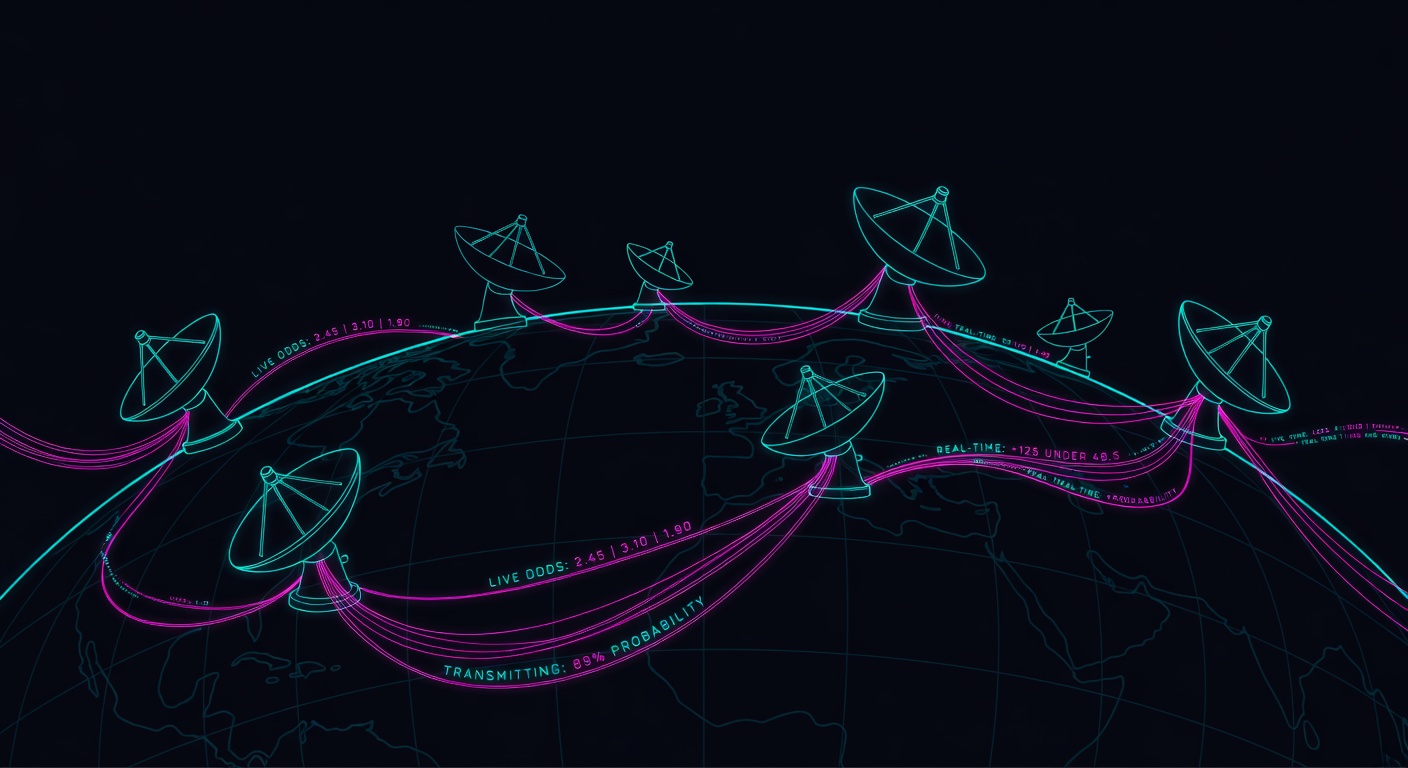
- Event is transmitted over a dedicated low-latency connection, often under 100 milliseconds for top-tier leagues.
- The feed arrives at a sportsbook's trading floor via API.
- A risk-management algorithm recalculates affected markets, incorporating liability positions and market signals from peer operators.
- New prices are pushed to the front end, usually within 200-500 milliseconds total.
For context, a television broadcast arrives at your set approximately 5-8 seconds after the event occurs. A betting feed arrives 50 to 80 times faster. The gap is the reason sharp bettors with fast data connections still find edges on in-play markets, and why operators invest so heavily in closing that window.
Round 3: The Scout Who Became a Problem
The vulnerability in this architecture is human. In 2018, Sportradar filed a civil lawsuit in New York against a group of scouts who had been feeding early data to unauthorised betting syndicates before transmitting it to Sportradar's official system. The scheme, sometimes called "corruption of data at source," let connected parties bet on events they already knew had happened. It affected minor European football leagues where scout oversight was thinner.
Sportradar responded by introducing a verification layer called Universal Fraud Detection System, which cross-references scout input against machine vision from broadcast feeds and betting-market signals. Unusual liability spikes in combination with data anomalies now trigger automatic review. The system flags several hundred matches per year for further investigation across football, tennis, and basketball.
The case illustrates something important about the data supply chain: it is not a neutral pipe. Every link in it, from the scout's keyboard to the operator's pricing engine, is a point where accuracy can be compromised, deliberately or otherwise.
Round 4: What Smaller Operators Do
Not every sportsbook can afford Sportradar's premium tier. Tier-two and tier-three operators in markets like Curaçao-licensed books often use aggregated feeds from data resellers such as BetRadar or SportsDataIO. These aggregators buy wholesale from the primaries and repackage the data at a lower price point, with higher latency and narrower sport coverage.
The consequence for bettors is usually invisible until something goes wrong. During a major event, a tier-two book running on a secondary feed may suspend markets two or three minutes before the final whistle while its primary-tier competitors stay open. The operator is managing the gap between what it knows and what the market already knows.
It is a structural disadvantage built into the cost curve of data procurement. The operators who pay more get faster, more reliable information. The operators who pay less pass that uncertainty onto their customers in the form of suspended markets and wider spreads.
That gap between premium and budget data infrastructure is, in miniature, the gap between what modern sportsbooks can offer and what they actually deliver. Most bettors never see the invoice. They only notice when the market goes dark at the worst possible moment.