Crypto Sportsbooks vs Crypto Casinos: Key Differences
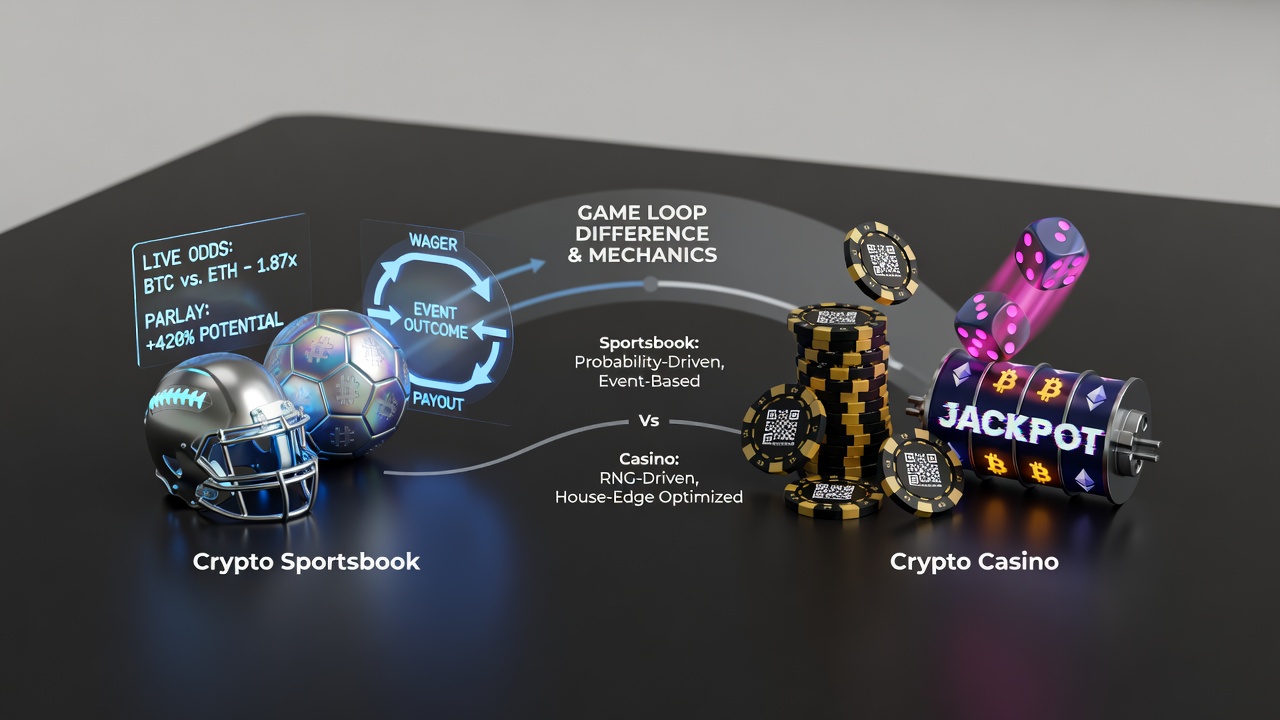
A sportsbook and a casino seem like the same product. Both take bets. Both have odds. Both exist to extract money. But the game loop is fundamentally different.
The deal
If you design games, you think about loops. The core loop is the action the player repeats. In Tetris, the loop is rotate-drop-clear. In Fortnite, the loop is land-loot-fight-escape. In a casino, the loop is bet-spin-resolution.
Crypto casinos and crypto sportsbooks share some mechanics but their loops are actually different.
Round 1: The Casino Loop
A slot or table game loop is tight: decide stakes, execute action, get immediate resolution, decide again. The entire loop takes 3-30 seconds depending on the game.
This creates a feedback mechanism that trains reward circuitry. Hit a small win, dopamine. Hit a loss, slight disappointment, but you are already making the next decision. The speed creates compulsion.
A casino's business model depends on volume. More spins equals more probability of player loss. The software is optimized for spin speed, reward clarity, and immediate re-engagement.
Betting operators (Stake, Rollbit) emphasize variance and shock. Huge wins, brutal losses. The loop is faster. You place a bet, wait seconds for resolution, place another.
Round 2: The Sportsbook Loop
A sportsbook loop is slower: decide market, decide odds, place bet, wait for event, wait for resolution, check result. The minimum loop is hours. Most loops are days (game starts tomorrow, resolves tomorrow night).
This creates a different reward structure. Anticipation builds. You place a bet and then you wait. The wait is part of the experience. The outcome, when it arrives, has weight because you have been thinking about it for hours or days.
A sportsbook's business model depends on the margin between bets and true odds. The more bets they take, the better the margin. But the margin comes from line adjustment, not from volume of the same customer.
Crypto sportsbooks (Stake, GG.Bet) use this mechanic but compress the feedback loop. Live betting means you can place a bet, watch for thirty seconds as the game unfolds, get resolution, and place another. This hybridizes the casino loop (fast feedback) with the sportsbook model (actual outcomes).
Round 3: The Retention Mechanics
Casinos retain players through what designers call "near-miss" mechanics. The reels almost line up. You almost hit the jackpot. Your brain interprets near-miss as "almost won" even though probability does not work that way.
Near-miss is addictive. It creates a psychological state where you feel you are about to win, so you keep playing.
Sportsbooks have a weaker near-miss mechanic. You can come close (cover the spread by 1 point) but near-miss is less effective at driving re-engagement because the outcome is past tense. The game is over. There is no next opportunity with the same bet.
However, live betting in sportsbooks creates something similar: the game is close, you could hedge your bet, you could double down, you could place a new bet on the next play. The live component reintroduces the near-miss and immediate re-engagement loop.
Round 4: The Variance Profile
Casinos offer controlled, designer-set variance. A slot machine has a specific RTP (96 percent) and volatility. The software is designed to hit certain payout frequencies.
Sportsbooks offer real-world variance. A sports outcome is genuinely uncertain. The variance comes from actual uncertainty, not algorithmic design.
Crypto-native products blur this. A crypto sportsbook might offer proprietary betting products (prediction markets, alternative odds) where the variance is designer-set like a casino game, but presented as sports betting.
Round 5: The User Acquisition Strategy
Casinos attract players through promotions, aesthetics, and game variety. They advertise "play Mega Moolah" not "play chance." The game's IP is the draw.
Sportsbooks attract players through odds availability and novelty. They advertise "live odds on every market" or "prop bets on everything." The variety of outcomes available is the draw.
Crypto platforms try to do both. They offer casino games AND sportsbook odds AND proprietary products (coin flip games, instant lotteries). They are maximizing the surface area for player engagement.
Round 6: The Future Difference
As regulation clarifies, this difference will become sharper. Sportsbooks will likely face different licensing requirements than casinos. The EU already treats them separately. This means the business model and design will have to diverge.
Crypto platforms that blend both product types might face regulatory pressure to choose which one they actually are. This will force design differentiation that does not currently exist.